Mainline Linux vs Vendor Kernels for Embedded Products#
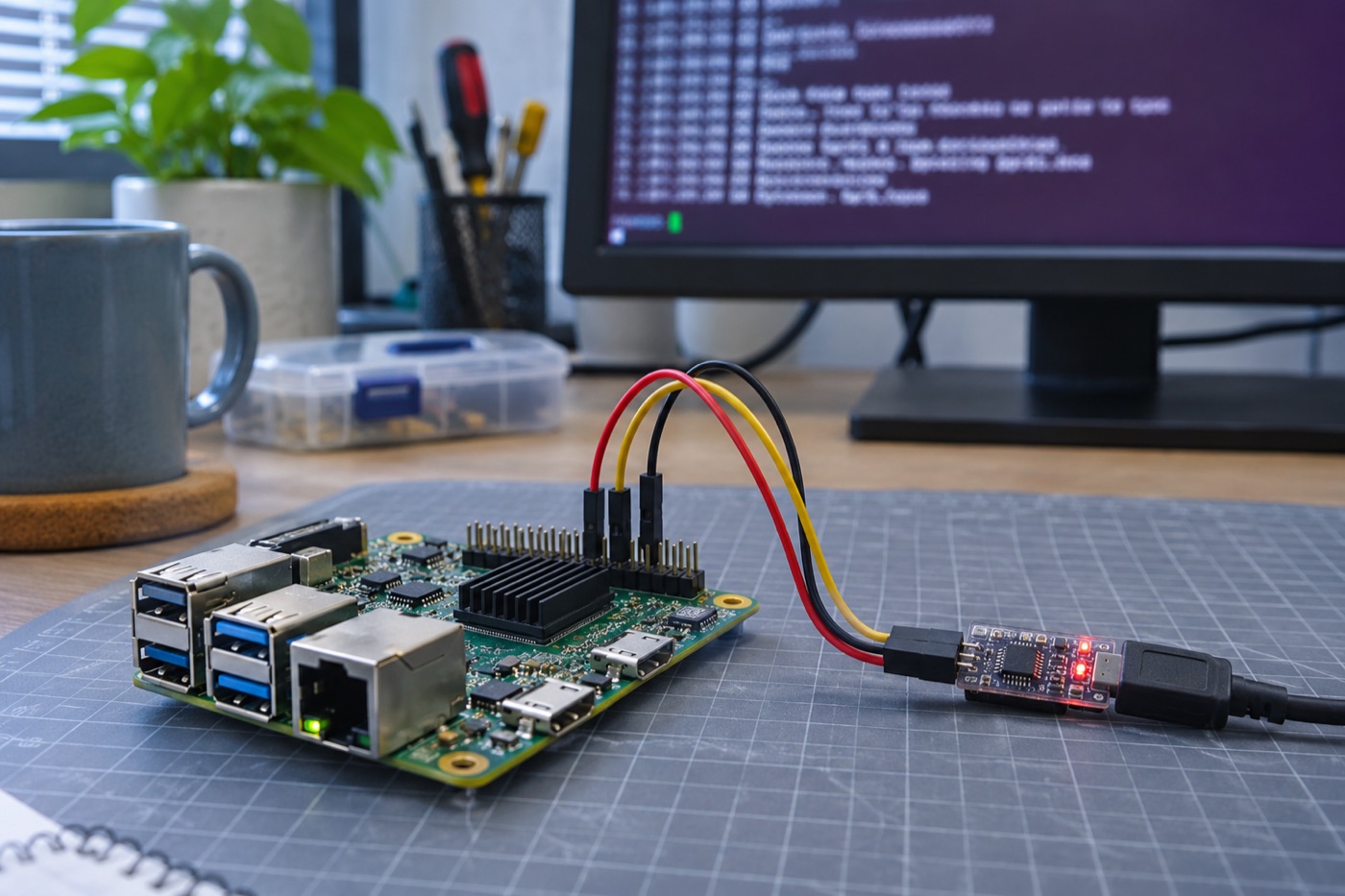
AI-generated engineering illustration.
Choose The Branch You Can Ship And Maintain#
Use an upstream-based stable kernel when the exact board can run its production workload with supported drivers, firmware, and userspace. Use a vendor BSP kernel when a required camera, display, accelerator, or low-power state still depends on a vendor implementation and the supplier can maintain the branch. Both choices require a release owner. A production team should identify its kernel source, local patch set, board device tree, and security update path before it qualifies the hardware.
Here, mainline means code accepted into upstream Linux. A production kernel built from upstream normally follows a suitable stable or longterm series. A vendor kernel is a tree maintained by a silicon or board supplier, often with patches around an upstream baseline. A third-party distribution can ship either kind. The name of the distribution offers little information about that kernel’s provenance.
A Boot Log Is The Start Of The Investigation#
Bring up the exact board and inventory how each required function works. Include a camera stream in the final format, display output with acceleration, Ethernet under load, suspend and wake sources, storage durability, and any watchdog behavior. Capture the boot log, kernel configuration, device tree, firmware revisions, and userspace components used. Different builds can share a release name while enabling different equipment.
| Product need | Evidence for an upstream-based build | Evidence for a vendor BSP build |
|---|---|---|
| Hardware support | Drivers, firmware and device tree for the shipping revision are available and tested | Maintained source and documented ownership for any vendor-only pieces |
| Media or acceleration | Dependencies and runtime behavior verified with the required application | Versioned SDK, named supported board, and a demonstrated upgrade path |
| Maintenance | Target stable series, update intake and device regression plan | Supplier backport policy, access to the updated source and a commitment matching product needs |
| Recovery | Bootloader, storage layout, rollback and field recovery work across test updates | Same recovery evidence plus a rebuild outside the supplier’s original image pipeline |
The embedded BSP quality checklist complements this inventory. It covers the questions that apply to either branch, including build reproduction, release notes, and handoff to a production team.
Count The Patches You Will Own#
Ask for the complete commit identifier and a clean recipe for rebuilding the delivered image. Compare the tree with the upstream base to understand which changes the team would need to maintain. Group them by reason. A device-tree change for a custom carrier is different from a large out-of-tree camera stack or a kernel module tied to a particular release. Record why every product-critical patch exists, whether an upstream equivalent is available, and who will rebase it during a future upgrade.
A supplier branch with a documented patch queue can be manageable. A board with an undocumented binary dependency can become costly even when most of the kernel comes from upstream. Identify the components that actually constrain upgrades. Where a vendor supplies a closed userspace library, confirm redistributability, runtime compatibility, and delivery of fixes. A generic promise to support Linux leaves these questions open.
Keep the build system decision separate. Yocto versus Buildroot for embedded products can help the team decide how to assemble images. Either build system still needs a pinned manifest for kernel code and generated artifacts. Rebuild on a clean machine and record the procedure before relying on it for an emergency update.
Prove That An Important Fix Can Reach A Device#
Pick a recent applicable fix as a rehearsal. Trace how the team discovered it, decided whether the device configuration was affected, obtained or backported the patch, built a new release, and packaged it for the fleet. Verify that the target boots, the hardware feature set survives, and the update can be staged and rolled back under the product’s policy. Measure the engineering effort and elapsed time. This gives procurement a better basis for judging maintenance promises.
Treat upstream longterm status as an input to planning. Published maintenance windows can change and do not establish support for the carrier, vendor modules, firmware, or product image. Have the project owner track all of those separately. If a chosen branch will age out before the device, schedule and price a migration while the team still has access to the original board and supplier support.
Move One Subsystem At A Time#
When a vendor tree is needed early, run an upstream-based candidate alongside it. Begin with the minimum boot and network path, then add one production subsystem at a time. Track interface behavior, latency, and failure recovery across branches. Moving camera capture, GPU, audio, and suspend in the same change can make regressions difficult to isolate.
Use one acceptance sheet for both implementations. On a gateway, test rate and stability with field I/O, network traffic, and periodic writes running concurrently. On a panel, exercise resume, display blanking, touch, and compositor restart. On a vision board, check sensor negotiation, dropped frames and capture recovery. The Linux gateway processor selection guide gives an example of requirements that can drive kernel choice beyond the driver checklist.
Document which old device images remain compatible with the new boot chain. Device-tree bindings, bootloader expectations, driver packaging, and root filesystem policy can change in a coordinated release. Qualify that release as a unit. The embedded secure boot and OTA design guide outlines how to plan an authenticated update and reliable system recovery.
Decision At Hardware Freeze#
Make a one-page record with the board revision, selected kernel, configuration, local dependency list, successful test artifacts, update owner, and exit condition for the branch. A common exit condition is support for the last vendor-only peripheral on an upstream baseline plus a successful update rehearsal. A vendor-backed product may instead commit to a documented branch until its planned end of support. In either case, the production release should make the active commitment easy for a new maintainer to find.
Ask a second engineer to build and boot that release without help from the board vendor. Record any artifacts or credentials that were harder to obtain than expected. This rehearsal exposes handoff problems while the original integration team can still resolve them.
FAQ#
Does a newer kernel automatically have better hardware support for my board?
Test the exact revision and required configuration. Support for the SoC can arrive before support for the board, its peripherals, or the media runtime used by the product.
Can I keep the vendor bootloader and upgrade only Linux?
Sometimes. Validate device-tree handoff, command line, firmware, partition selection, and recovery on the intended combination. Treat bootloader and kernel agreement as a release test.
Source Notes#
Reviewed November 23, 2026. Primary references include Linux kernel documentation, How the Development Process Works, the Linux Kernel Archives release and maintenance information, and the NXP i.MX Linux Release Notes as an example of a vendor BSP release. The qualification matrix and migration process are engineering recommendations.