Rockchip RK3588 Overview#
Quick Answer#
RK3588 is a high-performance Rockchip SoC for products that need more CPU, GPU, display, camera, video, and AI headroom than mid-range platforms such as RK3566 or RK3568. It is most relevant for edge AI terminals, multi-display systems, camera products, high-end Android devices, Linux edge computers, robotics prototypes, and industrial systems with heavier local processing.
It is not the first choice for simple HMI panels, low-cost Android screens, or small fanless control terminals. In those products, RK3566, RK3568, or RK3576 may offer a better balance of cost, power, thermal design, and development complexity.
What Is RK3588?#
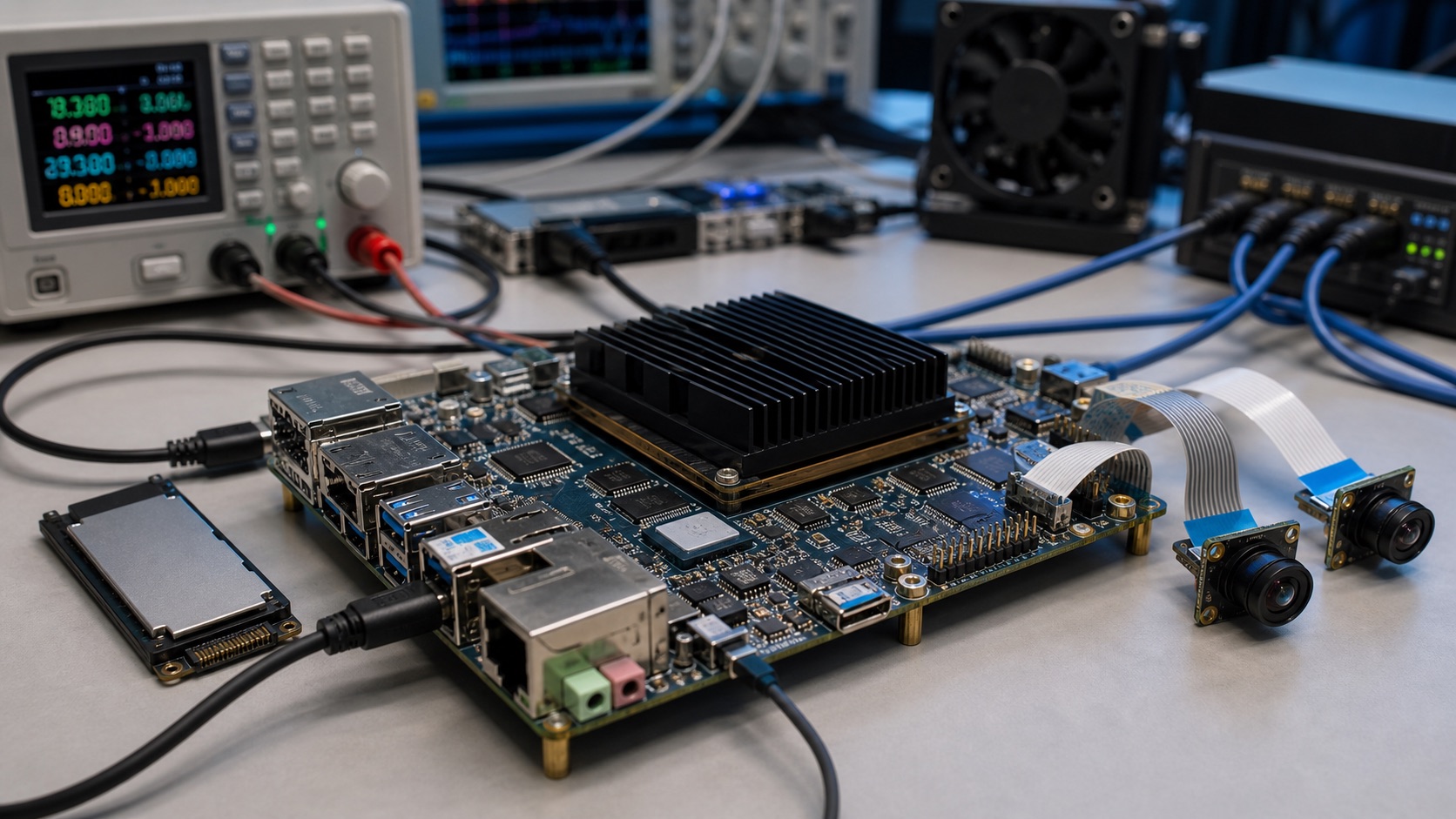
RK3588 is part of Rockchip’s higher-performance application processor family. In embedded products it is usually used on an SBC, compute module, or custom carrier board with DDR memory, eMMC or NVMe storage, Ethernet, USB, display connectors, camera connectors, audio, wireless modules, and expansion interfaces.
The final product capability depends heavily on the board design and BSP. The SoC may support rich features, but a specific board may expose only part of them.
Key Specifications to Verify#
| Area | What to Check |
|---|---|
| CPU | Big.LITTLE class CPU performance and sustained workload behavior |
| GPU | UI, 3D, graphics acceleration, and driver support for the target OS |
| NPU / AI | Model compatibility, toolchain maturity, and real measured throughput |
| Display | HDMI, eDP, MIPI DSI, multi-display, resolution, and rotation support |
| Camera | MIPI CSI lanes, sensor support, ISP pipeline, and camera HAL if Android is used |
| Storage | eMMC, SD, SATA or PCIe/NVMe options depending on board design |
| Networking | Ethernet, Wi-Fi, Bluetooth, USB, and PCIe expansion |
| Typical OS | Android or Linux depending on BSP and board vendor support |
Best-Fit Applications#
- Edge AI terminals
- Multi-camera vision systems
- Smart camera gateways
- High-end Android smart panels
- Digital signage and media systems
- Linux edge computers
- Robotics and machine vision prototypes
- Multi-display embedded products
Not Recommended For#
- Simple 4-inch to 10-inch HMI panels with basic UI
- Cost-sensitive Android panels
- Products with tight thermal limits and no heatsink space
- Long-lifecycle industrial products where vendor documentation and supply planning matter more than peak performance
- Designs where the team cannot validate camera, AI, and GPU drivers early
Android and Linux Support#
RK3588 can be used with Android or Linux, but the quality depends on the board vendor and BSP. For Android products, verify display rotation, touch, camera HAL, GPU acceleration, audio routing, suspend/resume, OTA, and production flashing tools. For Linux products, verify kernel version, device tree quality, camera support, GPU/VPU acceleration, container support, and long-term update strategy.
Do not select RK3588 only because a development board boots. Production readiness requires repeatable flashing, recovery mode, serial console, watchdog, thermal policy, and a stable software update process.
Interface Checklist#
| Interface | Verification Point |
|---|---|
| Display | Confirm exact interface, resolution, refresh rate, and multi-display behavior |
| Camera | Confirm sensor driver, ISP tuning, latency, and Android camera HAL if needed |
| Ethernet | Check single or dual Ethernet needs at board level |
| USB | Confirm host/OTG roles and bandwidth needs |
| PCIe | Verify NVMe, Wi-Fi, 4G/5G, or accelerator expansion requirements |
| Audio | Confirm codec, microphone, speaker, and routing |
| Industrial I/O | RS485, CAN, isolated GPIO, and wide-voltage input usually depend on carrier board design |
Power and Thermal Design#
RK3588 should be treated as a high-performance embedded processor. Sustained AI, video, camera, and graphics workloads can create thermal pressure in compact enclosures. Product teams should test final workloads inside the target enclosure, not only on an open development board.
Lifecycle and Supply Risk#
For professional products, verify SoC availability, module supplier lifecycle, DDR/eMMC sourcing, Wi-Fi module status, and replacement path. If the product requires very long industrial lifecycle and deep documentation, compare NXP i.MX or TI platforms as alternatives.
What To Ask The Supplier#
Ask for sustained thermal test conditions, Android/Linux BSP version, kernel branch, NPU toolkit status, camera sensor support, multi-display validation, recovery process, and production flashing method. For RK3588, the risk is less about whether the chip can run a demo and more about whether the whole board/BSP/enclosure combination can run the final workload every day.
Alternatives#
| Alternative | When to Consider |
|---|---|
| RK3576 | Lower power and cost for edge HMI or moderate AI |
| RK3568 | Industrial HMI, Linux gateway, and mid-range SBC applications |
| Qualcomm QCS platforms | Camera, AI, wireless, robotics, or premium Android requirements |
| NXP i.MX8M Plus | Long-lifecycle Linux, camera, AI, and industrial documentation needs |
Production Acceptance Notes#
RK3588 should be approved only when the product genuinely uses its headroom. The release decision should be based on measured workloads: display count, resolution, camera streams, AI model, video encode or decode, storage bandwidth, network traffic, and application CPU load. If the product is a simple HMI or gateway, a smaller SoC can reduce heat, cost, and software risk.
Thermal validation is the main gate. Test the final workload inside the intended enclosure with the selected heatsink, thermal pad, and mounting orientation. Record temperature, throttling, power draw, and UI responsiveness after sustained operation. Open-bench demos do not prove fanless reliability.
Software evidence is just as important. Ask for Android or Linux version, kernel branch, GPU/VPU/NPU support, camera HAL if Android is used, OTA, recovery mode, factory flashing, known issues, and source access. RK3588 can be powerful, but production success depends on the board vendor’s BSP discipline.
Supplier Evidence To Keep#
Keep a release file with board revision, memory size, storage part, heatsink, enclosure assumption, BSP version, update plan, recovery steps, and unresolved driver limitations. This prevents a performance-driven decision from becoming a maintenance problem later.
Final Shortlist Rule#
Keep RK3588 when the product has a measured need for its compute, media, camera, or AI headroom. Remove it when the same user experience can be delivered by RK3576, RK3568, i.MX8M Plus, Qualcomm QCS, or another lower-power platform with less thermal and BSP risk.
A good RK3588 decision should include evidence from the final application, not only a benchmark chart.
FAQ#
What is RK3588 best suited for?
RK3588 is best for high-performance SBCs, edge AI, multi-display products, camera systems, Android terminals, Linux edge computers, and robotics prototypes.
Is RK3588 a good choice for simple HMI?
Usually no. For simple HMI panels, RK3566, RK3568, RK3576, i.MX8M Mini, or AM62x may be more practical.
What is the biggest RK3588 risk?
Thermal design and BSP maturity are the biggest risks. Sustained workloads should be tested inside the final enclosure.