Factory Flashing and Device Provisioning for Embedded Linux#
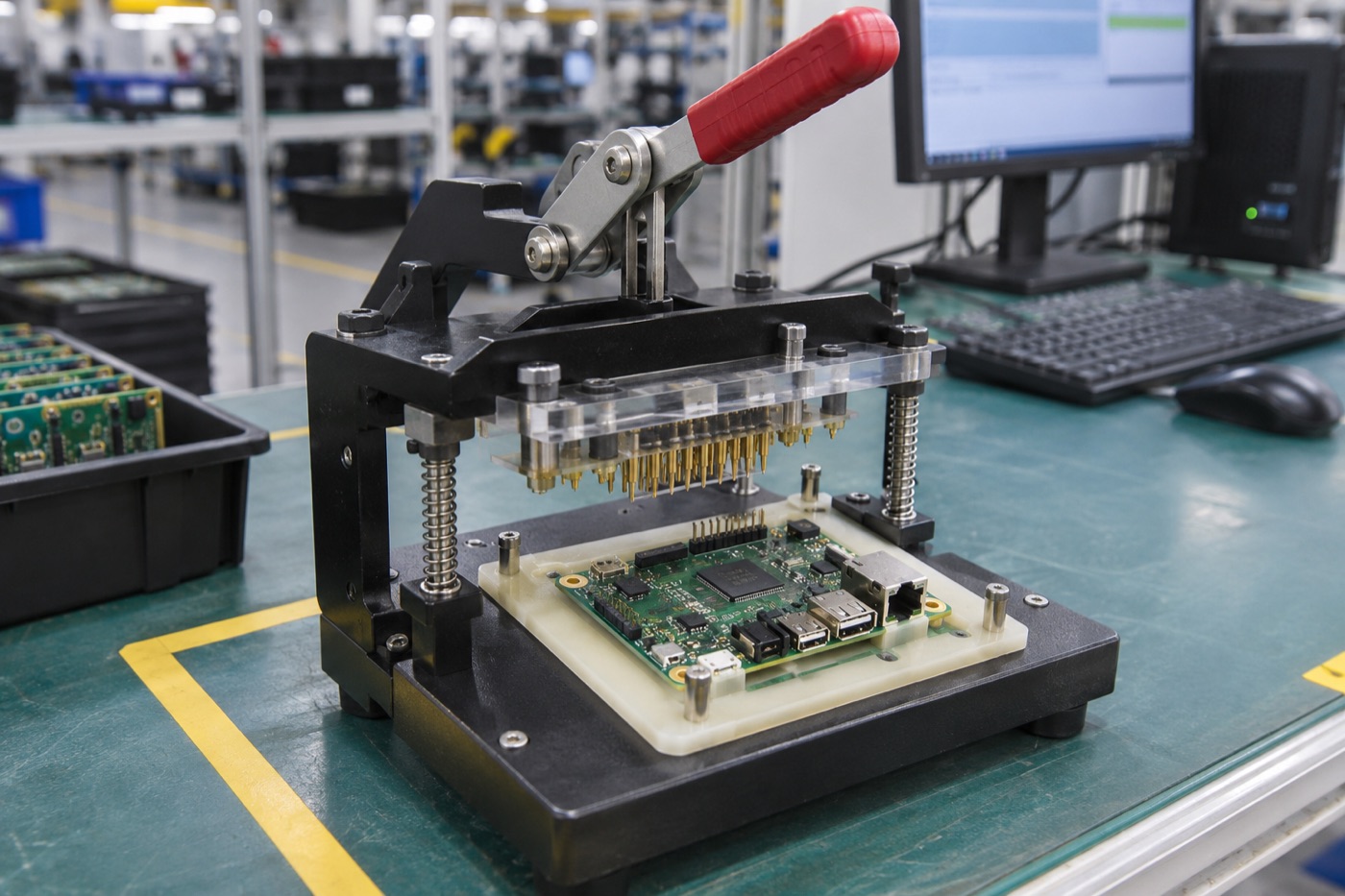
AI-generated engineering illustration.
Define What A Finished Unit Contains#
A practical factory line installs a verified release on the correct board, assigns the unit its intended identity and configuration, runs acceptance tests, and records enough information to service it later. Give each stage a pass condition and a safe way to resume. A station can report that a flash operation succeeded while leaving the wrong device tree, an unregistered serial, or stale calibration on the product.
Separate the shared software image from unit-specific information. Most units of one hardware revision should use the same versioned image. Serial numbers, device credentials, calibration, and traceability records belong to a controlled workflow that associates values with the physical board. The test engineer should be able to identify the installed release and explain how the line passed the unit without inspecting private material.
Package A Release And A Compatibility Record#
Build a release bundle containing the software artifacts, the expected digests, target board revisions, storage layout, and the station recipe that knows how to install and verify it. Include the bootloader, device tree, and any co-processor firmware that change the release’s compatibility. Use immutable release identifiers. The embedded Linux build-system comparison describes two common ways to assemble the images.
Have the station reject a version or board combination outside the authorized release manifest. Identify a board through a reliable hardware or manufacturing identifier and cross-check it with the job’s variant. A sticker selected by an operator may identify a work order, but the hardware check catches an assembly or fixture mix-up. Archive the manifest and the software build identifier with the manufacturing record.
Partition layout belongs in that record. A product might reserve space for alternate boot slots, device configuration, and calibration. Decide which areas a normal reflash may erase. Have a separate policy for depot repair on an already provisioned unit. The embedded storage and partitioning considerations help when media sizes or models vary across revisions.
Make Retries Safe To Perform#
Treat a unit as a record with stages such as identified, flashed, provisioned, tested, and released. Store stage evidence alongside the unit identifier, station, timestamp, and recipe version. A step that failed or timed out should leave enough state to determine whether it can be retried as-is or needs controlled rework.
| Stage | Evidence to record | Handling interruption |
|---|---|---|
| Board identification | Measured or read identifier, revision, variant and intended bundle | Re-identify before writing |
| Flash and verification | Release ID, target identity and verified outputs | Reinstall when the recorded image state is uncertain |
| Identity and calibration | Issuance record, successful association with unit, calibration revision | Reconcile reservations and completed writes before retry |
| Acceptance | Required peripheral results and final boot or functional check | Retest the affected stage after repair and record the disposition |
A station tracking only a serial in its UI may issue another identity after a network timeout, even if the first issuance succeeded. Use one transaction or a recoverable record that can answer whether a request already completed. Bind credential issuance to the physical unit and audit the transaction where the product requires it. Keep access scoped by station and operator role. Prefer devices and services that can establish an identity without revealing private keys in station logs or release bundles.
Keep Secure Boot And Repair In The Same Design Review#
Agree on how a trusted image is verified before production, and how a station confirms the device has reached the intended lifecycle state. U-Boot FIT signature verification is one documented building block for checking signed images in a supported boot chain. The SoC’s root of trust, signing policy, provisioning mechanism, and repair authority determine what else the product needs. The secure boot and OTA signing guide covers the relationship between boot trust and field updates.
Production steps that irreversibly change device configuration should have an approved sequence for the exact silicon and board. Give the station an independent verification step and a way to quarantine a unit whose result is uncertain. Verify the repair and replacement path on the same lifecycle state that customers receive. A lab image on a development unit does not demonstrate that a field return can be updated under production policy.
Test A Whole Unit At Line Rate#
Start with fast checks that catch handling errors. Then test boot and version, relevant interfaces, sensor or display behavior, and a representative application path. Use test limits owned by the product team. If calibration is needed, record the fixture, software revision, and measurement disposition. Retest the operations affected by rework and tie results back to the original hardware record wherever the process permits.
Measure stations across a realistic lot with a mix of normal and rework units. Separate image transfer, boot, functional testing, and operator time so the bottleneck is visible. Rehearse an interrupted flash, a station losing its manufacturing service connection, a board variant mismatch, and a serial mismatch. Include a power interruption on suitable fixture hardware. The embedded Linux power-loss qualification guide describes downstream recovery tests for the finished device.
The release gate should answer a service question months later. Given a unit serial, an authorized engineer should be able to determine what code the factory installed, which revisions the acceptance test covered, and which service images are appropriate. Validate that lookup before the first volume run.
Decide How A Station Recovers Its Own Work#
Fixtures and host machines fail too. Publish a controlled station setup with tool versions, drivers, fixture identifiers, test recipes, and the expected cable orientation or pin contact checks. Train a second operator to set up a spare station from that package. Verify that switching stations preserves work-order restrictions and does not create a second record for a board already in process.
Treat fixture repairs and recipe changes as changes to the measurement system. Retest known-good and known-fail examples before reopening the station. If the station can run offline, explicitly define which operations it can complete, how it authenticates a release bundle, and how it reconciles results when it reconnects. Staging verified images offline may be straightforward, while identity assignment may need an available issuing service or preallocated identifiers.
FAQ#
Can the line clone one working disk image to every unit?
Use a versioned image for common software. Apply identity, variant settings, and calibration through a controlled per-unit step. Review which storage areas the installation procedure owns.
How should an interrupted provisioning run resume?
Read the current state of the unit and reconcile it with the manufacturing record. Continue once the station knows which operations completed and which scope is safe to repeat.
Source Notes#
Reviewed November 23, 2026. Primary references include U-Boot FIT Signature Verification documentation, the Yocto Project documentation for Kickstart and Wic image generation, and MediaTek’s Genio Tools documentation as an example of a platform-specific flash workflow. The station design, retry rules, and record model are editorial recommendations.