ESP32-C6 Guide for Wi-Fi 6, Matter, and Thread#
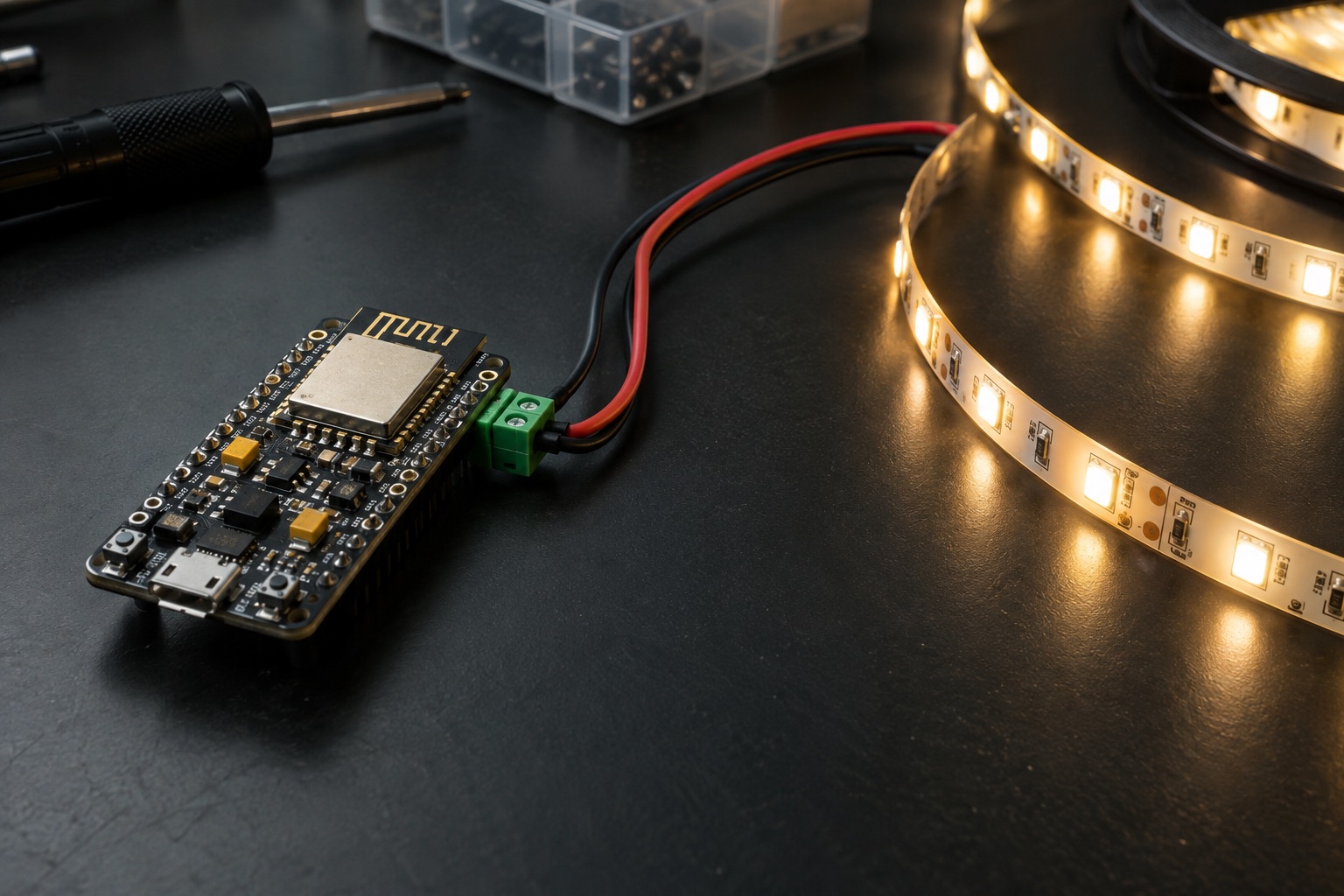
AI-generated engineering illustration; not a photograph of certified Matter hardware.
Quick Answer#
ESP32-C6 combines 2.4 GHz Wi-Fi 6, Bluetooth LE, and IEEE 802.15.4 in a microcontroller SoC. It is a candidate for connected-home products where Wi-Fi or Thread endpoint support matters. Its Wi-Fi 6 capability does not imply 5 GHz or 6 GHz operation. The official C6 overview specifies a RISC-V application processor up to 160 MHz and a separate low-power processor.
Choose the intended network role before choosing the firmware stack. A Matter endpoint, a Thread border router, and a Zigbee bridge are different products. Having several radio capabilities does not make their software roles interchangeable or establish reliable concurrent operation. This guide provides architectural and validation advice, not interoperability certification or measured throughput claims.
Separate Radio, Network, And Application Layers#
Wi-Fi and IEEE 802.15.4 describe different connectivity foundations. Thread builds an IP mesh network over IEEE 802.15.4. Zigbee also uses IEEE 802.15.4 but is a different stack. Matter operates at the application layer over supported IP transports; it does not make a Zigbee endpoint a Matter device automatically.
Bluetooth LE is commonly involved in nearby commissioning workflows, while ordinary application traffic may use another transport. That separation affects power, memory, and testing. Do not count a successful phone pairing as proof that the commissioned product remains reachable across its intended operational network.
| Proposed Product | Architecture Question | Evidence Needed |
|---|---|---|
| Wi-Fi Matter light | Can the customer’s network support the flow? | Commissioning and recovery across routers |
| Thread Matter sensor | What Thread infrastructure is available? | Parent recovery and border-router integration |
| Zigbee controller | Which network and device behavior are required? | Compatibility with intended coordinators |
| Protocol bridge | How are device functions translated? | Mapping, state synchronization, failure handling |
| Border router | What provides the complete routing system? | Host, radio, software, and maintenance design |
The table identifies design questions rather than promising that a single reference example implements every role. Use a supported architecture for the chosen SDK release and confirm its limitations before committing hardware.
Decide Between Wi-Fi And Thread#
Wi-Fi may simplify installation where suitable coverage and credentials already exist. It also makes the product dependent on customer router configuration and reconnection behavior. For wall-powered equipment, that can be a reasonable trade. For long-life battery products, measure the complete duty cycle rather than assuming suitability from a radio feature list.
Thread can suit small mesh endpoints, but the deployment must provide the required infrastructure and operational support. Determine who supplies the border router and who helps when the network changes. A device cannot promise the same installation experience in a prepared smart home and a location without compatible infrastructure.
Do not add both operating modes merely because the silicon offers them. Supporting two customer-facing transports expands configuration states, test combinations, documentation, and support burden. It can be justified for distinct markets, but make the benefit explicit and maintain a clear behavior when changing modes.
Put Wi-Fi 6 Claims In Context#
Radio-generation labels do not predict end-to-end message delay. Access-point behavior, interference, network load, retransmissions, application scheduling, and backend response all contribute. Test the supported network population, including older infrastructure, because a customer may never use the capabilities highlighted in a launch presentation.
If energy savings depend on a particular network feature, verify that the selected SDK and access point support the necessary behavior. Keep the configuration with the measurements. Avoid extending one laboratory result to every home router or enterprise deployment. A useful report states what was tested and where the conclusion stops.
For command-driven products, record latency distributions and failures rather than only averages. A light that responds quickly most of the time but occasionally stalls during reconnection can still feel unreliable. Define an acceptable local fallback and document which actions remain available when the external controller is unreachable.
Commissioning Needs Failure Tests#
Design a commissioning state machine with explicit timeouts and restart rules. Include cancellation, incorrect network credentials, interruption after partial setup, and attempts to configure a device already associated with an owner. Ensure the device returns to a known state without leaking credentials into logs or requiring factory tools.
Matter development adds device identity, data-model choices, and ecosystem testing to ordinary embedded work. Use the ESP-Matter documentation to select a supported baseline. Treat successful operation of an example as a development milestone; the final product still requires its own qualification and applicable certification process.
Plan ownership transfer and reset behavior. Users may sell the product, move it to another home, or replace controllers. Clearly separate network removal, customer-data removal, and manufacturing identity. If these actions are conflated, service procedures can create security or recoverability problems that are difficult to fix remotely.
Coexistence And Memory Are Shared Constraints#
When protocols share radio resources, traffic patterns matter. Evaluate commissioning while normal activity continues, and run update traffic while the application processes commands. Inspect retries, packet loss, CPU load, and memory peaks. Independent demonstrations of each radio do not establish the quality of their combined behavior.
Make protocol concurrency a documented requirement, not an accidental side effect. If the product needs only one operational stack at a time, enforce that state clearly. If simultaneous behavior is necessary, verify support and scheduling limits against the C6 coexistence documentation and the selected component versions.
Memory planning should include commissioning and update peaks, not just a connected idle state. Record stack margin and allocation failures with production features enabled. Reserve growth for data-model changes, diagnostics, and credential handling. Disabling observability to squeeze in another feature can make future field failures far harder to diagnose.
Power And Physical Integration#
Measure power in the complete enclosure with indicators, sensors, and regulators included. Radio transmission can cause short supply demands that are invisible in a slow average reading. Test startup and reconnection near the minimum operating supply, and retain a trace when resets occur.
Antenna placement should be reviewed alongside the mechanical layout. Lighting drivers, metal plates, and wiring can affect both interference and radiation. Use the intended enclosure, mounting position, and cable routing during evaluation. An open-board range test does not establish installed performance.
For a lighting controller, also test command bursts and transitions in the attached low-voltage load. The application should remain responsive while state is stored and reported. This is a concurrency requirement, not a claim that the MCU itself supplies load-driving circuitry or electrical isolation.
Production Acceptance Matrix#
| Test Condition | Observe | Retain With The Result |
|---|---|---|
| Fresh commissioning | Completion, cancellation, retry path | Phone, controller, SDK versions |
| Network outage | Local behavior and recovery time | Infrastructure and outage duration |
| Busy radio environment | Missed commands and delay | Traffic profile and channel conditions |
| Firmware replacement | Recovery after interruption | Image hashes and partition layout |
| Customer reset | Data removal and recommissioning | Identity and reset policy |
Run these scenarios on pilot hardware and repeat after changes to the antenna, networking stack, or power supply. Define the pass criteria from customer needs. A stable example project is not an adequate substitute for the final application under failure conditions.
FAQ#
Does ESP32-C6 support 5 GHz Wi-Fi? No. Its Wi-Fi capability is in the 2.4 GHz band. Wi-Fi 6 is not synonymous with dual-band operation.
Does choosing C6 make a product Matter-certified? No. Silicon capability and SDK support are inputs to development. Certification and interoperability evidence apply to the finished product and its implementation.
When should H2 be compared with C6? Compare H2 when the endpoint needs Bluetooth LE or IEEE 802.15.4 without native Wi-Fi. Evaluate the complete power, memory, infrastructure, and update requirements.
Sources And Related Guides#
Reviewed September 18, 2026. Radio and processor facts follow Espressif’s linked C6 overview; implementation starting points follow the ESP-Matter guide. All acceptance tests are recommendations, not claimed laboratory results. Continue with ESP32 selection and ESP-IDF security and OTA.