Rockchip RV1106 Guide: Building a Supportable Embedded Vision Camera#
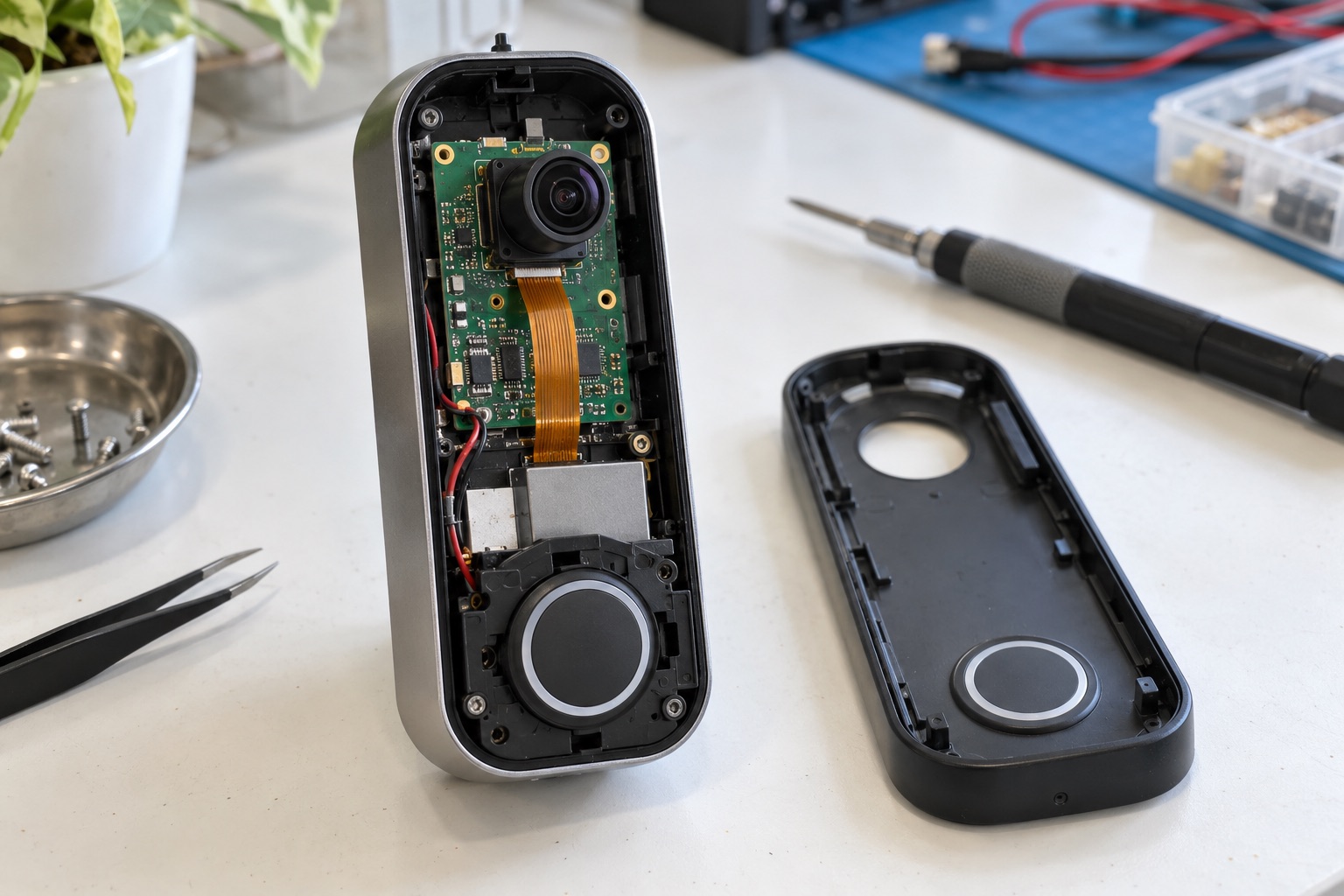
AI-generated engineering illustration, not a verified RV1106 board photograph or a measured test setup.
Quick Answer#
RV1106 is a candidate for compact embedded vision products where camera acquisition, image processing, inference, and compressed video matter more than desktop computing. Evaluate the complete sensor-to-result pipeline before choosing a module. The decisive questions are whether the intended sensor is supported, whether the model runs within available memory, and whether the supplier provides a maintainable production software package.
It should not be treated as a smaller general-purpose workstation. A smart doorbell, occupancy sensor, or inspection endpoint has different requirements from a browser-based kiosk. This article separates documented platform direction from engineering recommendations; it contains no claimed hands-on performance measurements.
Establish The Hardware Boundary#
Rockchip’s RV1106 brief datasheet presents a vision-oriented processor with a Cortex-A7 application CPU and dedicated image-processing and neural-network functions. Obtain the detailed documentation for the exact ordering code before committing a schematic or memory budget.
Module names often hide important differences in memory, flash, networking, and accessible pins. Create a configuration record containing the SoC variant, RAM arrangement, storage capacity, sensor module, lens, board revision, and supplied SDK release. A demo for a related board is not a substitute for that record.
Pay particular attention to resources reserved by the multimedia subsystem. Physical RAM capacity and application-available RAM are not equivalent. Camera buffers, model tensors, encoder queues, kernel allocations, and networking must coexist during peak operation, including startup and update workflows.
Start With The Sensor And Lens#
Select the camera assembly around the scene, not just pixel count. Entrance monitoring may need difficult backlight handling; a production-line sensor may need consistent illumination and controlled motion blur. The lens, exposure strategy, and mounting geometry can dominate useful image quality.
Ask for the exact sensor driver and tuning files that accompany the BSP. A sensor that produces frames is not necessarily tuned for acceptable color, noise, or exposure transitions. Request evidence for the lens and illumination arrangement close to your own product.
Validate day-to-night transitions, reflective surfaces, moving subjects, and low-contrast targets. Retain representative input frames with consent and appropriate data handling. A model cannot recover information that was lost through blur, clipping, poor focus, or an unsuitable exposure interval.
Define A Complete Processing Pipeline#
Write the pipeline explicitly: capture, image correction, crop or resize, tensor preparation, inference, postprocessing, decision logic, and optional encoding or upload. Assign a latency and memory allowance to each stage. This makes bottlenecks visible before optimization begins.
| Pipeline Stage | Evidence To Record | Common Failure |
|---|---|---|
| Capture | Sensor mode and timestamps | Frames arrive unevenly |
| Preprocessing | Dimensions and color conversion | Training and runtime differ |
| Inference | Model hash and runtime version | Unsupported operations cause fallback |
| Postprocessing | Thresholds and execution time | CPU processing dominates latency |
| Delivery | Queue depth and network delay | Old detections reach the application |
Measure end-to-end event age, not only inference duration. A fast accelerator can still produce stale results if frames queue upstream. For many monitoring products, dropping an outdated frame is preferable to processing every frame after its useful deadline has passed.
Validate The Model Toolchain Early#
Convert a representative model before final hardware selection. Record the original framework, exported graph, conversion-tool version, quantization data, and resulting artifact. Do not assume that a model supported by another Rockchip family uses an identical deployment path on RV1106.
Compare accuracy before and after conversion using held-out examples that resemble deployment conditions. Include rare but consequential failures, not just the most common class. Quantization may change confidence distributions, requiring threshold review rather than a superficial check that outputs still appear plausible.
Keep preprocessing identical between evaluation and production. Channel order, normalization, letterboxing, and crop coordinates are part of the model contract. A mismatch can look like a weak accelerator when the actual defect is incorrect input preparation.
Budget Memory For Concurrency#
Test the real combination of functions. Inference alone may fit comfortably, while inference plus video recording, encrypted networking, and an update download may exhaust memory. Track high-water marks and allocation failures under these combined conditions.
Calculate image-buffer sizes from stride and format, not width times height alone. Alignment and multiple queued buffers can materially increase usage. Reducing buffer counts may save RAM but can also expose scheduling jitter, so validate both throughput and resilience after changing them.
Avoid designing around a single successful boot. Repeatedly start and stop streams, reconnect clients, rotate recordings, and reload models. Long-running resource leaks and fragmentation can invalidate an otherwise convincing short demonstration.
Design For Network And Power Failures#
A camera must have an explicit policy for lost connectivity. Decide whether it stores events locally, discards old records, or reduces capture frequency. Bound queues so an extended outage cannot consume all storage or prevent current events from being handled.
Power-loss testing should cover recording, configuration updates, and firmware installation. Distinguish filesystem recovery from valid application state. Store configuration atomically and ensure that incomplete recordings do not prevent the next startup or fill storage indefinitely.
Document the behavior of external illumination and other switched loads. Their current transients can affect the camera supply or introduce image artifacts. Test with the intended wiring and enclosure because a short laboratory cable may conceal installation-related problems.
Treat Security As A Product Workflow#
Map the supported boot and update mechanisms for the exact BSP rather than assuming that every Rockchip security feature is exposed. Identify who signs releases, who provisions identities, and how field units reject unauthorized or incompatible images.
Minimize exposed services and remove development credentials before shipment. Separate manufacturing access from customer diagnostics. A recovery interface should have a deliberate authorization policy, especially when the device observes private spaces or connects to a customer network.
Define a model-update policy as well as a firmware-update policy. A new model can change memory consumption, detection behavior, and privacy characteristics without changing the kernel. Version the model and application together, and provide a tested rollback decision when accuracy regresses.
Supplier Acceptance Checklist#
Request a reproducible image build, sensor tuning package, model-conversion example, recovery instructions, and a documented maintenance owner. Ask which components are source-available, binary-only, or subject to separate access terms. These boundaries affect your ability to fix a field problem.
For pilot production, preserve the tested configuration and image hashes. Compare samples from multiple manufacturing lots under the same scene conditions. Changes in lens focus, sensor substitution, or illumination components can alter system performance without changing the advertised processor.
FAQ#
Is RV1106 a replacement for an RK3588 SBC? Usually not. It targets a different balance of camera integration, resources, and cost. Choose it for a bounded vision workload rather than assuming desktop-style software portability.
Does an NPU guarantee accurate detection? No. Accuracy depends on the model, training data, sensor image quality, preprocessing, and deployment conditions. Accelerator capability mainly affects which computation can run efficiently.
What should be tested before selecting a module? At minimum, the intended sensor mode, converted model, simultaneous recording or networking, peak memory use, interrupted updates, and recovery from lost power.
Sources And Related Guides#
Continue with the camera interface guide, NPU performance guide, and secure update guide to turn the camera prototype into a testable product plan.
Reviewed October 27, 2026 using the official Rockchip brief linked above and Rockchip RV1106 boot-component release notes. Recommendations are not vendor guarantees. For larger application workloads, compare the RK3588 overview and the Rockchip vendor guide.