NXP i.MX91 Guide: Choosing a Linux Processor for Industrial Gateways#
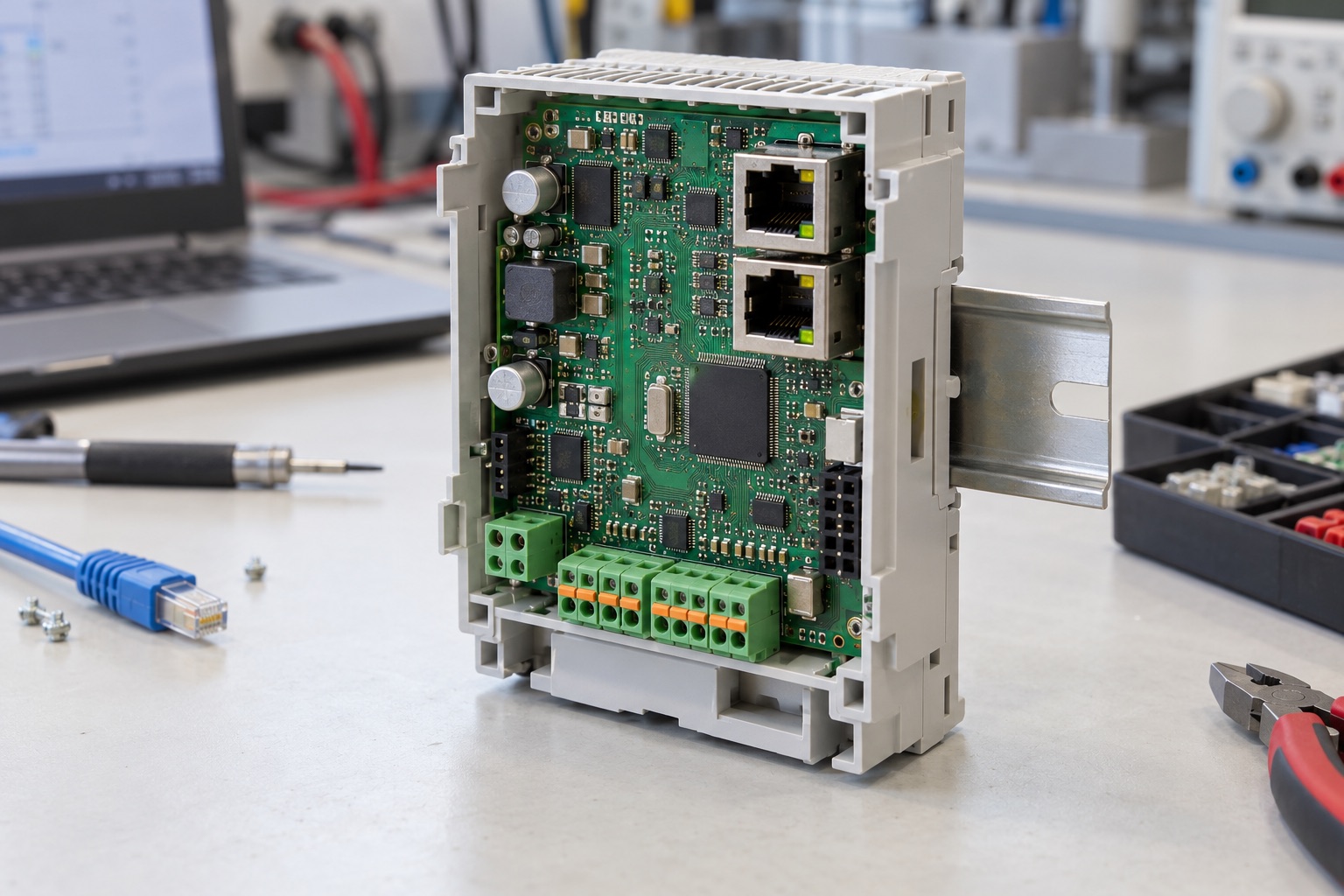
AI-generated engineering illustration, not a verified NXP board photograph or a measured test setup.
Quick Answer#
NXP i.MX91 is a candidate for cost-conscious embedded Linux controllers and gateways that need an application processor without assuming a large multimedia or AI workload. Select it by measuring the complete communications and application load, then checking the chosen module’s interfaces and software maintenance. A processor family name alone cannot establish gateway throughput, security posture, or industrial reliability.
The strongest evaluation begins with a bounded product: required protocols, message rates, local storage, user interface, and recovery expectations. This guide draws on official documentation and offers engineering evaluation methods. It does not claim independent benchmarks or certify a finished product.
Understand The Platform Class#
The NXP i.MX91 product page identifies a single Cortex-A55 application processor aimed at embedded Linux applications. Treat the exact device documentation as the authority for interfaces and operating limits. A carrier board or system-on-module may expose only a subset of the silicon’s possibilities.
Distinguish the processor from supporting components. For example, a recommended power-management device is a separate part with its own integration requirements, not an extra function magically present in every module. Power sequencing, reset supervision, and external transceivers remain board-level responsibilities.
For a procurement specification, name the module ordering code, memory and storage configuration, temperature grade, and software release. Ask for a schematic or interface document that identifies which pins are available simultaneously. Connector counts alone can conceal shared resources and optional component populations.
Define The Gateway Workload#
List every protocol endpoint and its traffic pattern. Periodic sensor polling differs from bursts of event messages or file transfers. Include encryption, parsing, database writes, logging, and remote management rather than benchmarking only raw packet movement.
A single application core can be entirely adequate for a well-bounded workload. It can also become overloaded when unrelated services wake together. Test the coincidence of worst-case events: reconnecting clients, rotating logs, applying configuration, and publishing buffered data after an outage.
| Requirement | Useful Measurement | Acceptance Question |
|---|---|---|
| Protocol translation | End-to-end message latency | Are deadlines met during bursts? |
| Local persistence | Durable write completion | Is acknowledged data actually recoverable? |
| Encrypted connections | Handshake and reconnect cost | Can all clients recover together? |
| Remote administration | Resource use during maintenance | Does service remain responsive? |
| Long outages | Queue growth and replay rate | Can the backlog drain safely? |
Choose limits before optimization. A maximum queue length, explicit retry policy, and overload response make the system more predictable than hoping that additional buffering will absorb every deployment condition.
Validate The BSP And Build Process#
NXP’s meta-imx repository includes supported machine configurations and release integration for i.MX platforms. Follow the documentation for the selected release and board rather than mixing layers from unrelated branches. A board booting with a custom combination does not establish supportability.
Require a clean, reproducible build that produces the deployable image and package manifest. Archive the layer revisions, toolchain, configuration, and any vendor patches. Determine whether your module supplier maintains its own fork and how fixes move from upstream sources into that fork.
Exercise all required peripherals on the intended kernel. For industrial gateways, prioritize Ethernet link recovery, serial framing, watchdog reset, timekeeping, and storage behavior. A successful graphical demonstration is not meaningful evidence for these less visible but operationally critical functions.
Separate Network Ports From Network Behavior#
Two physical connectors do not by themselves define a switch, router, or deterministic network endpoint. Identify the actual controller and PHY topology, driver support, VLAN behavior, and bridging policy. Verify the configuration after a factory reset and after an interrupted upgrade.
Measure application throughput with the security settings enabled. Plaintext throughput can overstate the capacity available to a production deployment. Include small messages because per-packet and per-connection overhead may matter more than bulk transfer speed in a sensor gateway.
Test cable removal, address changes, duplicate addresses, and upstream outages. Decide how the device communicates degraded status without flooding logs or repeatedly resetting. Recovery should be observable through bounded diagnostics that remain available when the main application is struggling.
Design Storage For Field Conditions#
Translate retention requirements into a write budget. Record expected message volume, database amplification, log rotation, and firmware image storage. A storage device with sufficient capacity can still be unsuitable for the write pattern or environmental conditions.
Use transactions or atomic replacement where application state requires consistency. Then test power interruption during actual writes. Filesystem repair does not prove that a configuration file, certificate store, or sequence counter represents a valid application state.
Define what happens when storage fills. Preserve enough capacity for boot, recovery, and critical diagnostics. Prefer an explicit retention policy over allowing an old backlog to consume the space needed to install the next security update.
Make Security Ownership Concrete#
Start with a threat model covering physical access, remote services, credentials, and the software supply chain. Map each requirement to a supported mechanism on the exact device and BSP. Do not substitute a security-feature list for an implemented provisioning process.
Document signing authority, key custody, device identity, and recovery authorization. Test production settings on expendable units before committing irreversible configuration. Service personnel need a procedure consistent with the restrictions that manufacturing actually enables.
Updates require compatibility checks and recovery from interrupted installation. Decide which data survives rollback and whether older software can interpret it. A signed image can still be operationally wrong for a particular board revision or database schema.
Compare i.MX91 With i.MX93#
Use the i.MX93 guide when requirements include a different compute or acceleration profile. Compare the complete application requirements, not just model numbers. Additional capability is valuable only when the associated board, software, and power costs are justified.
A useful comparison runs the same protocol workload, encrypted sessions, persistence policy, and management agent on both candidates. Record peak memory, response-time percentiles, power, and recovery behavior. This reveals whether the smaller platform is comfortably sufficient or operating too close to its limits.
Keep future requirements specific. “More AI later” is not an actionable reason to purchase a larger processor. A named model, input rate, accuracy target, and maintenance plan can support a defensible platform decision.
FAQ#
Is i.MX91 suitable for a Linux industrial gateway? It is a reasonable candidate when the selected board exposes the necessary interfaces and the measured software workload fits. Industrial suitability also depends on the complete assembly and supplier commitments.
Does using NXP Linux software remove maintenance work? No. Someone must track releases, evaluate vulnerabilities, integrate fixes, and deliver updates. A documented upstream baseline helps, but it does not operate your product fleet.
What is the most useful prototype test? Run all required communications, encrypted connections, persistence, and remote management together, then introduce outages and power interruptions. This exposes interactions that isolated benchmarks miss.
Sources And Review Scope#
Use the Linux gateway selection guide, industrial interface guide, and Yocto versus Buildroot comparison when defining the carrier and software baseline.
Reviewed October 27, 2026 against NXP’s product information and official software repository linked above. Suggested tests are editorial guidance, not measured i.MX91 results. Consult the NXP i.MX vendor section for related processor options and confirm exact module availability directly with suppliers.