TI AM67A Guide: Evaluating a Multi-Camera Edge AI System#
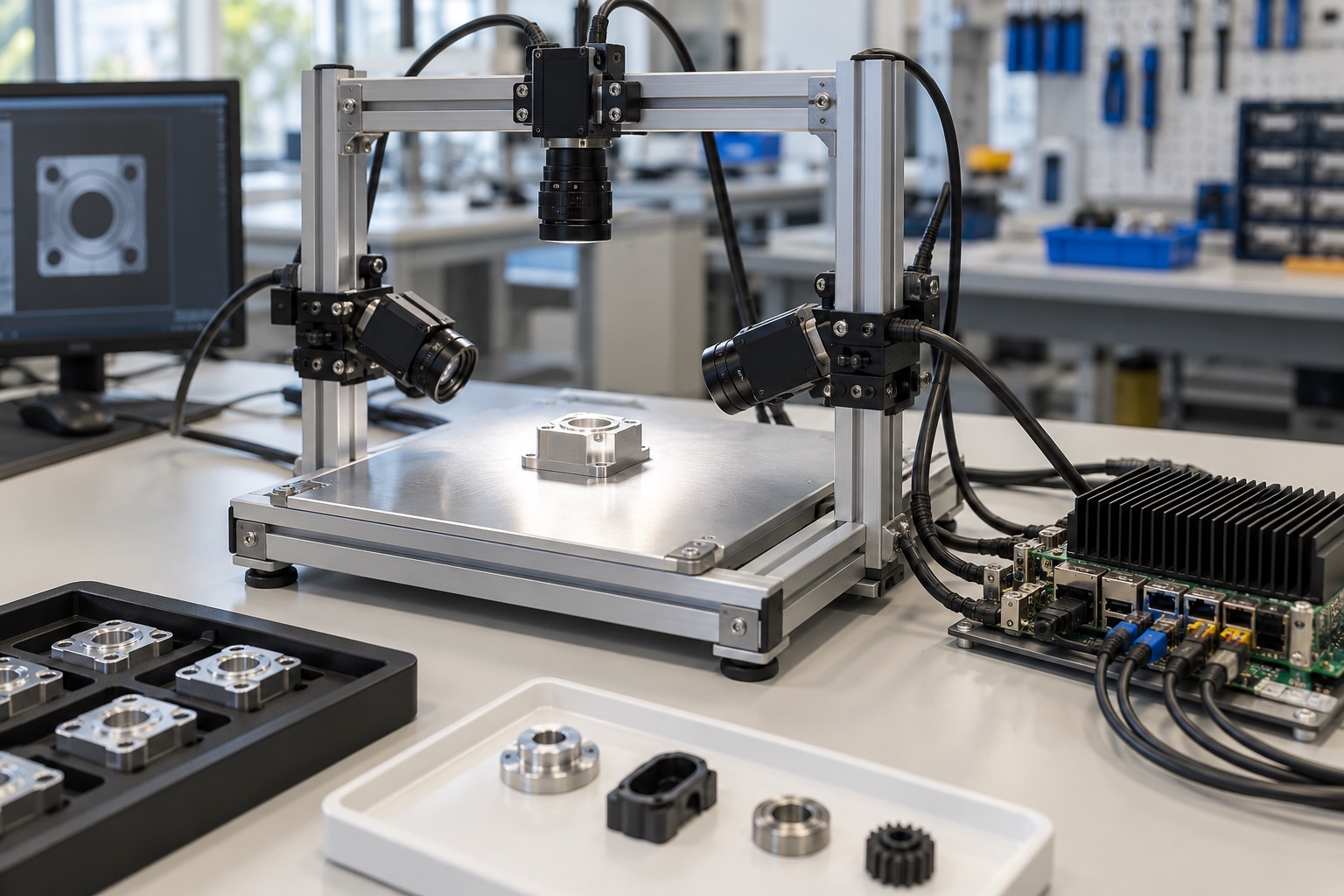
AI-generated engineering illustration, not a verified AM67A board photograph or a measured test setup.
Quick Answer#
AM67A is a candidate for edge systems that combine several camera streams with local inference and application processing. Evaluate it as a complete vision platform rather than purchasing by its advertised AI throughput. The useful result is a timely, accurate application decision while all required streams, encoders, displays, and communications are active.
For a multi-camera product, synchronization and data movement can matter as much as inference speed. This guide uses official platform information to frame a validation process. It does not claim measured frame rates, supported sensor combinations, or a universal number of simultaneous maximum-resolution streams.
Establish What The Silicon Claim Means#
The TI AM67A product page describes Cortex-A53 application processing, an R5F subsystem, and an AI accelerator advertised at 4 TOPS. TI also highlights camera image processing, including RGB-IR use cases. These are platform capabilities, not an application benchmark.
Check the exact part, package, memory configuration, and board routing. Camera interfaces may require bridge devices, serializers, or specific sensor modules. The carrier schematic determines which combinations are electrically available, while the selected software release determines which combinations are usable.
Define the camera configuration as a table of sensor mode, pixel format, frame rate, link topology, and processing destination. This prevents a vague requirement such as “four cameras” from hiding very different bandwidth and synchronization demands.
Start With The Decision Deadline#
Specify the maximum acceptable age of a result at the point where the application uses it. For object tracking, this may be more important than average frames per second. A pipeline can report high throughput while operating on frames that are already too old.
Break the deadline into exposure, transfer, image processing, inference, postprocessing, and delivery. Include queueing between stages. Record timestamps using a defined clock relationship, especially when cameras or external controllers maintain their own time bases.
Choose an overload policy before deployment. Dropping old frames, reducing an optional stream, or simplifying inference may be preferable to accumulating latency. The policy should preserve the most important application behavior and make degraded operation visible to operators.
Treat Synchronization As A Separate Requirement#
Multiple streams arriving near each other in software are not necessarily synchronized exposures. Determine whether the application requires hardware triggering, approximate alignment, or merely independent observations. The requirement changes sensor selection, wiring, and software architecture.
Validate synchronization with a physical event visible to all relevant cameras. Software timestamps alone can conceal delays before buffers reach the application. Retain the test method and uncertainty so later firmware changes can be evaluated against the same standard.
Calibration also requires lifecycle planning. Mounting changes, lens replacement, vibration, or servicing can invalidate assumptions. Store calibration identifiers with the device configuration and define when recalibration is required rather than treating factory calibration as permanent.
Validate The AI Deployment Path#
Choose a representative model and verify conversion with the TI-supported toolchain for the selected release. Record model format, supported operators, quantization settings, and runtime dependencies. A successful conversion of a sample network does not prove support for your own graph.
Compare accuracy using deployment-like input after the complete preprocessing chain. Include difficult lighting, motion blur, partial occlusion, and relevant rare cases. Quantization and image processing can alter results even when the neural-network architecture is unchanged.
| Question | Evidence | Why It Matters |
|---|---|---|
| Does the graph deploy? | Conversion report and artifact hash | Finds unsupported operations early |
| Is accuracy retained? | Held-out evaluation by scenario | Reveals conversion and input effects |
| Is latency bounded? | End-to-end percentile measurements | Exposes queueing and fallback work |
| Do streams coexist? | Full concurrent workload trace | Finds bandwidth contention |
| Is the result repeatable? | Locked software and test inputs | Supports later regression analysis |
Measure CPU-side work as carefully as accelerator execution. Resizing, tensor conversion, tracking, and result serialization can dominate a small model’s total cost. Optimize the actual bottleneck rather than assuming that the advertised TOPS figure is the limiting resource.
Budget Memory Traffic#
Account for every frame copy and format conversion. A pipeline may move an image through capture, processing, inference, encoding, and display buffers. Each extra copy consumes bandwidth and can increase latency even when there is enough physical RAM.
Use buffer sharing only with a clear ownership and synchronization model. Avoiding copies is beneficial, but reusing a buffer before a consumer finishes can create intermittent corruption. Such errors may appear only under sustained load or when one stream temporarily stalls.
Test with the final stream count, resolution, and recording settings. Include model loading and background storage activity. A single-camera demonstration cannot establish the headroom of a multi-camera deployment because contention changes as shared resources become busy.
Evaluate Image Quality Before Model Tuning#
Confirm sensor drivers, lens settings, exposure control, and tuning files with the supplier. Image-processing support is not equivalent to a tuned production camera. The exact sensor and optical assembly determine what data reaches the model.
For RGB-IR applications, validate the complete illumination and filtering arrangement. Do not assume a marketing reference implies every sensor mode or optical configuration is supported. Measure behavior under the lighting conditions and transitions expected in the finished installation.
Keep image-quality regressions distinct from model regressions. Preserve representative frames and configuration hashes, subject to applicable privacy requirements. This makes it possible to identify whether changed results came from optics, firmware, preprocessing, or the network itself.
Plan Thermal And Operational Recovery#
Run the complete application until the enclosure reaches a stable thermal condition. Record ambient temperature, mounting orientation, cooling hardware, clocks, and latency. A brief open-bench test does not establish sustained performance inside a sealed product.
Inject camera disconnects and corrupted input while monitoring recovery. Decide whether one failed camera should restart only its pipeline or the entire system. Independent recovery can improve availability, but it requires explicit resource cleanup and state management.
Updates must preserve compatibility among kernel drivers, accelerator runtime, models, and application code. Package these dependencies deliberately and test rollback. A model-only update can still exceed memory or timing limits, so it belongs in the release qualification process.
FAQ#
Does 4 TOPS predict application frame rate? No. Precision, operator support, preprocessing, memory traffic, stream concurrency, and postprocessing all affect useful throughput. Measure the actual pipeline with the intended model and input.
Can AM67A process any four-camera arrangement? That cannot be inferred from a headline. Verify sensor modes, interface routing, bandwidth, driver support, synchronization, and simultaneous processing requirements for the exact board.
When should AM67A be compared with a smaller TI platform? When the application uses fewer streams or simpler inference. Compare the measured workload and integration cost rather than assuming that additional acceleration automatically improves the product.
Sources And Related Guides#
Review the camera interface guide, NPU throughput analysis, and thermal design guide when preparing acceptance criteria.
Reviewed October 27, 2026 using TI AM67A specifications and linked technical documentation. All validation procedures are editorial recommendations. Compare the AM62A guide, AM68A guide, and TI vendor overview for adjacent platform choices.