NXP i.MX8ULP Guide: Battery-Powered Linux Without Guessing Battery Life#
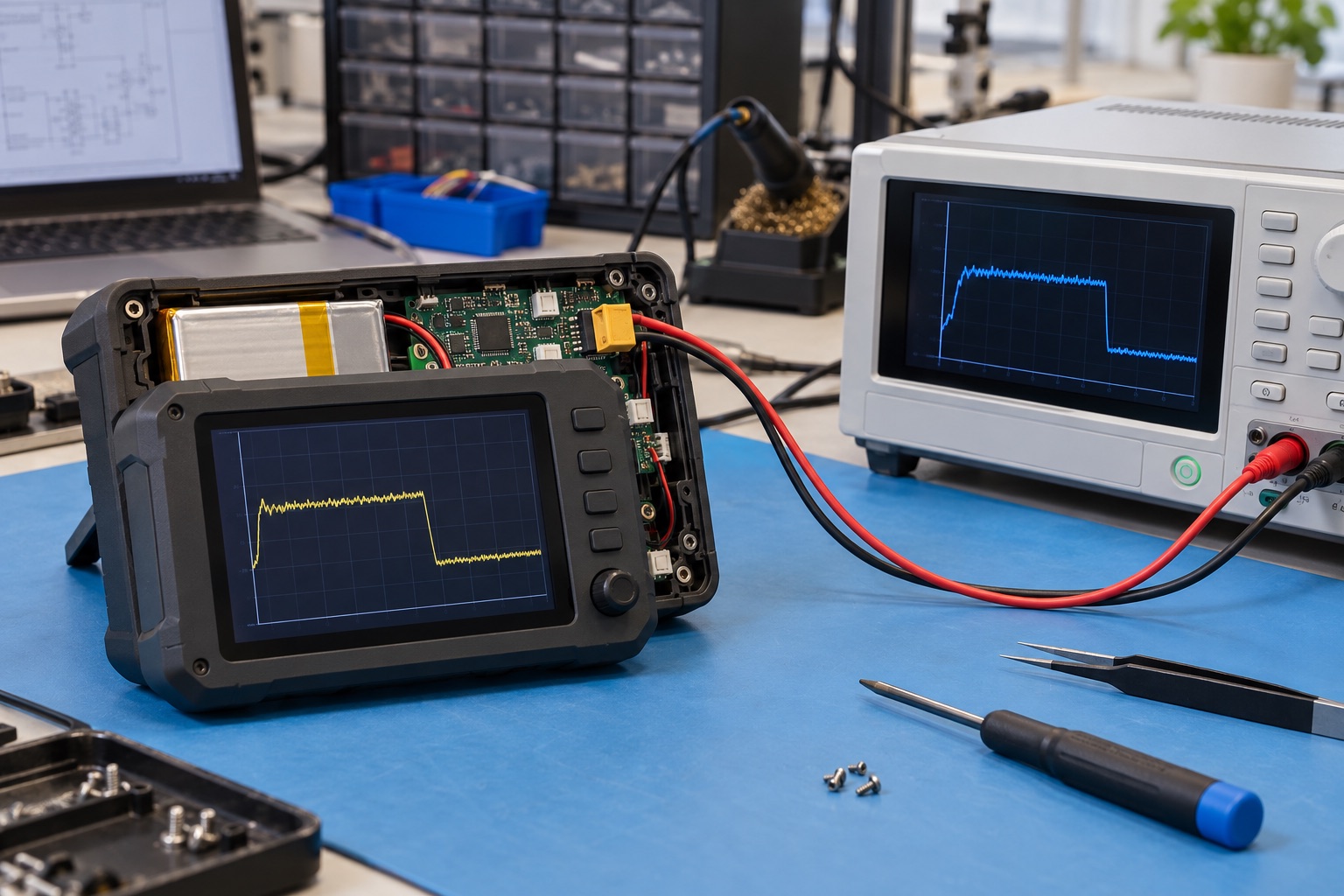
AI-generated engineering illustration, not a verified i.MX8ULP board photograph or a measured test setup.
Quick Answer#
i.MX8ULP is worth evaluating for products that need Linux-class application software but spend meaningful time in lower-power operating states. Its value depends on how well the product separates background activity from work that needs the application processors. Select it through measured duty-cycle energy and wake behavior, not a single attractive standby-current figure.
A portable instrument, intermittently used interface, or connected battery device can benefit from this architectural approach. A continuously active graphics workload may have a very different energy profile. The recommendations here are based on documentation and system-design reasoning, not an independent battery-life test.
Understand The Processing Domains#
The NXP i.MX8ULP product documentation describes Cortex-A35 application processing alongside a Cortex-M33 domain and specialized multimedia functions. NXP’s Energy Flex architecture makes power-domain planning central to product design rather than an optional optimization after software is complete.
Do not treat the microcontroller domain as a spare CPU that automatically saves energy. It needs assigned responsibilities, suitable peripheral access, a communication protocol, and firmware that can operate while other parts of the system are inactive. Those choices determine whether useful work can avoid waking Linux.
Document ownership of every shared resource. Sensors, clocks, memory regions, and interrupt routing need clear rules across transitions. Ambiguous ownership can cause a wake failure or stale reading that appears only after hours of otherwise normal operation.
Build An Energy Model Before A Battery Claim#
Express daily energy as the sum of time spent in each operating state multiplied by its measured power, plus transition energy. This model is more useful than quoting active and sleep current without explaining how often the device changes state.
Include the entire product: display backlight, radios, sensors, storage, regulators, and charging circuitry. Processor savings can be overshadowed by an always-on peripheral or inefficient power conversion. Measure at the battery input as well as selected rails when diagnosing consumption.
| State | What Must Remain Active | Measurement To Capture |
|---|---|---|
| Waiting | Wake sources and essential sensing | Stable input power |
| Sampling | Sensor and control-domain work | Energy per sample cycle |
| User interaction | Display and application workload | Sustained power and duration |
| Synchronization | Radio and data processing | Energy per successful transfer |
| Transition | Startup and shutdown dependencies | Energy and elapsed time |
Treat battery capacity as usable capacity under defined conditions, not a label value. Temperature, aging, discharge rate, and cutoff behavior affect the result. Report assumptions alongside any projected runtime and update them after enclosure-level measurements.
Make Wake Latency A Product Requirement#
Specify how quickly each event must become visible to the user. A button press, scheduled sample, alarm, and network request may need different handling. Some events can be acknowledged locally before Linux is fully ready; others require application services immediately.
Measure from the external event to the useful outcome. A kernel resume timestamp does not include display initialization, application scheduling, database access, or network recovery. These later stages can dominate perceived responsiveness even when the processor wakes quickly.
Test repeated transitions with events arriving near state boundaries. A sensor interrupt just as the system suspends is an important race condition. Keep a trace of wake reason, state transition, and application acknowledgment so rare failures can be reproduced.
Design Communication Between Domains#
Define a versioned message protocol between application and control firmware. Include sequence numbers, timeouts, error reporting, and behavior after either side resets. Shared memory is a transport mechanism, not a complete consistency or recovery strategy.
Prefer explicit commands and acknowledgments for changes that affect power or sensor configuration. Establish which side owns timestamps and how clock drift is handled. Measurements collected while Linux is inactive should retain enough context to be interpreted correctly after resume.
Bound queues on both sides. If the application domain remains unavailable, the control firmware needs a documented policy for overwriting, compressing, or preserving samples. Unbounded buffering merely turns a temporary outage into an eventual memory failure.
Budget The Display And User Interface#
A display can substantially change the energy case for a battery product. Measure backlight settings, update frequency, rendering workload, and time before dimming. A visually simple interface can still trigger continuous rendering if animations or polling are implemented carelessly.
Test the actual toolkit and screen resolution early. Include font loading, image decoding, touch handling, and the largest data view. Smooth interaction on a static demonstration screen does not establish acceptable performance for a real instrument application.
Define state restoration after sleep. The interface should show whether displayed measurements are current, cached, or still being refreshed. Avoid presenting stale data as live merely because restoring the previous screen is faster than reacquiring a reading.
Coordinate Updates Across Firmware Images#
The application image and control firmware form a compatibility pair. Version them together and define supported combinations. An otherwise valid Linux rollback can fail if it expects an older control protocol that is no longer installed.
Plan interrupted-update behavior for each component. Test power loss between writing the first image and committing the second. A robust design either preserves a compatible pair or enters a documented recovery mode instead of booting an undefined combination.
Keep security configuration and service access in the same review. Production key handling, authenticated updates, and recovery permissions must match the actual provisioning process. Do not infer an implemented security policy merely from the presence of a hardware security block.
Evaluate The BSP And Module Supplier#
Use the official NXP power-domain application note to understand the intended architecture, then verify your board’s implementation. Regulator population, external memory, and connected peripherals can prevent a reference low-power state from translating directly to a custom assembly.
Ask the supplier for the supported BSP, control-domain examples, suspend limitations, and measurement conditions. Request a reproducible build and a known recovery procedure. A module advertised for low power should come with evidence that explains what was actually running during measurement.
Maintain a regression suite covering cold boot, repeated suspend, wake-source combinations, depleted battery, and firmware rollback. Power optimization is not complete if it saves energy while making recovery unreliable. Reliability and energy need to be evaluated together.
FAQ#
Does i.MX8ULP guarantee long battery life? No. Runtime depends on the whole assembly, duty cycle, battery characteristics, and software behavior. Measure the completed product under representative conditions before making a claim.
Why use a control domain alongside Linux? It can handle suitable background tasks and wake decisions without continuously running the application domain. This requires deliberate peripheral ownership and communication design.
Can Linux and control firmware be updated independently? Only within a defined compatibility policy. Independent installation without version checks can leave mismatched protocols or an unrecoverable update sequence.
Sources And Related Guides#
For implementation planning, consult the BSP evaluation guide, display interface guide, and secure update guide.
Reviewed October 27, 2026 using NXP’s product and power-domain documentation linked above. No current or runtime measurements are claimed. Compare the i.MX91 gateway guide for continuously connected controllers and the NXP vendor overview for other platform classes.