Rockchip RK3588 Series Guide#
Quick Answer#
The RK3588 series is for projects that genuinely need high CPU, GPU, video, display, camera, or AI headroom. It is a strong candidate for edge AI terminals, multi-camera systems, high-end Android panels, Linux edge computers, robotics prototypes, and premium embedded multimedia devices.
It is not the disciplined default for simple HMI panels. If a product does not need the extra performance, RK3576 or RK3568 may reduce cost, power, heat, and BSP complexity.
Product Fit#
| Product Type | Fit |
|---|---|
| Multi-camera AI terminal | Strong fit if camera pipeline is validated |
| High-end Android panel | Good fit for premium UI and multimedia |
| Linux edge computer | Strong fit with NVMe, Ethernet, and containers |
| Simple HMI | Usually overkill |
| Long-lifecycle industrial Linux | Compare NXP or TI if documentation/lifecycle dominates |
What To Verify#
RK3588-class products should be tested with the final workload: AI model, camera count, display count, video encode/decode, storage writes, network load, and enclosure thermal target.
Do not select RK3588 only because a development board boots a demo. Production readiness requires BSP source access, recovery mode, serial console, watchdog, OTA or update process, thermal policy, and reliable factory flashing.
BSP and Software Risk#
For Android, check display, touch, camera HAL, GPU acceleration, audio, sleep/wake, OTA, and production flashing. For Linux, check kernel branch, GPU/VPU/NPU userspace, camera pipeline, container support, NVMe support, and long-term update policy.
Thermal Design#
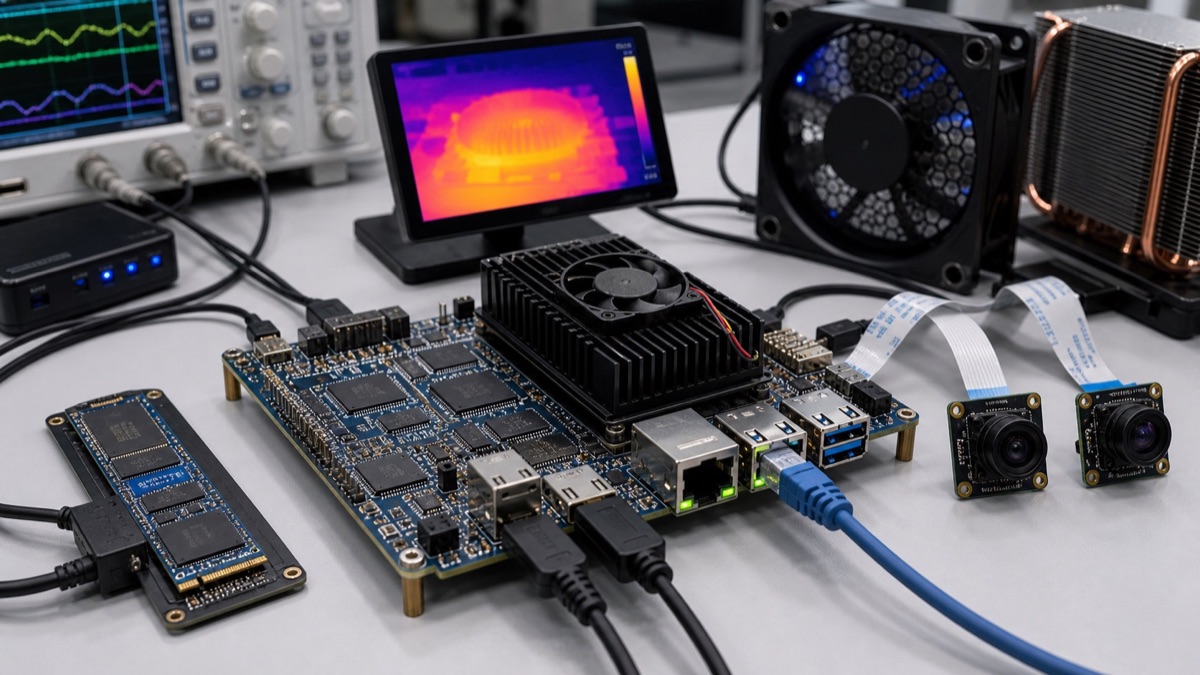
RK3588 can create real thermal pressure in compact fanless products. Ask for sustained performance data, ambient temperature, heatsink details, and enclosure conditions. A peak benchmark is not a product validation.
Supplier Questions#
- Which RK3588 variant is used?
- Is the NPU toolchain usable for the target model?
- Which camera sensors are supported?
- Is multi-display validated?
- Is NVMe boot or data storage supported?
- What is the sustained thermal result?
- Is the BSP maintained for production?
Production Validation Notes#
For RK3588, early validation should include the real AI model, camera count, display count, storage path, network load, and enclosure. A board can pass a short demo while still failing a sustained fanless workload. Keep thermal logs, BSP version, NPU toolkit version, camera sensor list, and flashing procedure in the project record.
If the product is a commercial Android terminal, OTA and recovery matter as much as benchmark performance. If it is a Linux edge computer, confirm container support, NVMe behavior, serial console, watchdog, and field diagnostics.
When Not To Use RK3588#
Avoid RK3588 when the product only needs a simple UI, one display, light networking, and low BOM cost. The performance may be impressive, but unused performance still creates cost, heat, power, and maintenance overhead.
Performance Headroom Versus Product Complexity#
RK3588-class platforms are attractive because they offer substantial CPU, GPU, video, display, camera, and AI headroom compared with mid-range SoCs. That headroom is useful for edge AI terminals, multi-camera devices, high-resolution Android products, Linux edge computers, digital signage, robotics prototypes, and systems that need local processing rather than only a simple interface.
The tradeoff is complexity. High-performance boards need better thermal design, stronger power supply planning, more careful BSP validation, and a clearer update strategy. A product that only needs a basic HMI, simple gateway, or single display usually does not benefit from RK3588 enough to justify the added cost and heat. RK3568, RK3576, i.MX8M, AM62x, or Qualcomm QCS may be better depending on the real workload.
RK3588 should be selected when the workload has been described in concrete terms: display count, resolution, camera count, AI model, video encode/decode, storage bandwidth, operating system, enclosure temperature, and expected production lifetime.
Validation Workflow#
Test sustained workloads, not only short demos. Run the final UI, video pipeline, camera input, AI model, storage writes, and network traffic together. Measure thermals inside the target enclosure and record whether throttling occurs. For Android, validate display rotation, GPU, camera HAL, audio, OTA, recovery, and factory tools. For Linux, validate kernel version, GPU/VPU stack, device tree quality, container or application runtime, watchdog, and update rollback.
Ask suppliers for known BSP limitations, source access, release notes, thermal recommendations, compatible heatsinks, and long-term maintenance plans. If the supplier cannot explain the software update process and recovery method, the board is not ready for a production product even if the hardware demo is impressive.
Release Decision Criteria#
RK3588 should be released only with sustained workload evidence. The report should include thermal results, CPU/GPU/NPU load, display count, camera behavior, storage performance, power draw, and BSP version. A short benchmark or demo video is not enough for a production product.
If the product does not use RK3588’s headroom, a smaller SoC may be easier to cool, cheaper to source, and simpler to maintain. If the product does use the headroom, the release decision should include heatsink, enclosure, and software throttling policy.
Acceptance Notes#
RK3588 acceptance should include a thermal and software maintenance sign-off. The hardware team should approve heatsink and enclosure assumptions, while the software team should approve kernel, GPU/VPU, NPU, camera, OTA, and recovery behavior. If either side is still relying on a demo image or open-bench test, the product is not ready for release.
Production Acceptance Notes#
RK3588-class products need a release review that covers performance, heat, and software at the same time. The platform is strong for edge AI, multi-camera, high-end Android, and Linux edge computing, but it can be excessive for simple panels. The accepted design should show why RK3588 is necessary and which smaller platforms were rejected.
Run sustained tests with the final UI, camera streams, AI model, video pipeline, storage writes, network traffic, and enclosure. Record throttling and surface temperature. If a board passes only with a fan or open bench, the fanless product design is not complete.
Ask the supplier for BSP release notes, known GPU/VPU/NPU issues, camera support details, OTA process, recovery tools, and factory flashing documentation. A powerful board without maintainable software is not a production platform.
Supplier Evidence To Keep#
Keep the accepted heatsink, enclosure path, board revision, memory size, storage part, kernel branch, Android or Linux version, update plan, recovery method, and open driver limitations. This record helps prevent late redesigns.
Final Shortlist Rule#
Keep RK3588-class hardware when the final workload proves the need for high CPU, GPU, video, camera, or AI headroom. Remove it when the project is using RK3588 only as a comfort margin, because that margin can become heat, cost, and maintenance burden.
FAQ#
Is RK3588 good for industrial products?
It can be, but industrial success depends on board design, thermal design, BSP maturity, and supply planning.
When should RK3576 be considered instead?
When the product needs better performance than RK3568 but not RK3588-class power and cost.