MediaTek Genio vs Rockchip for Embedded AIoT#
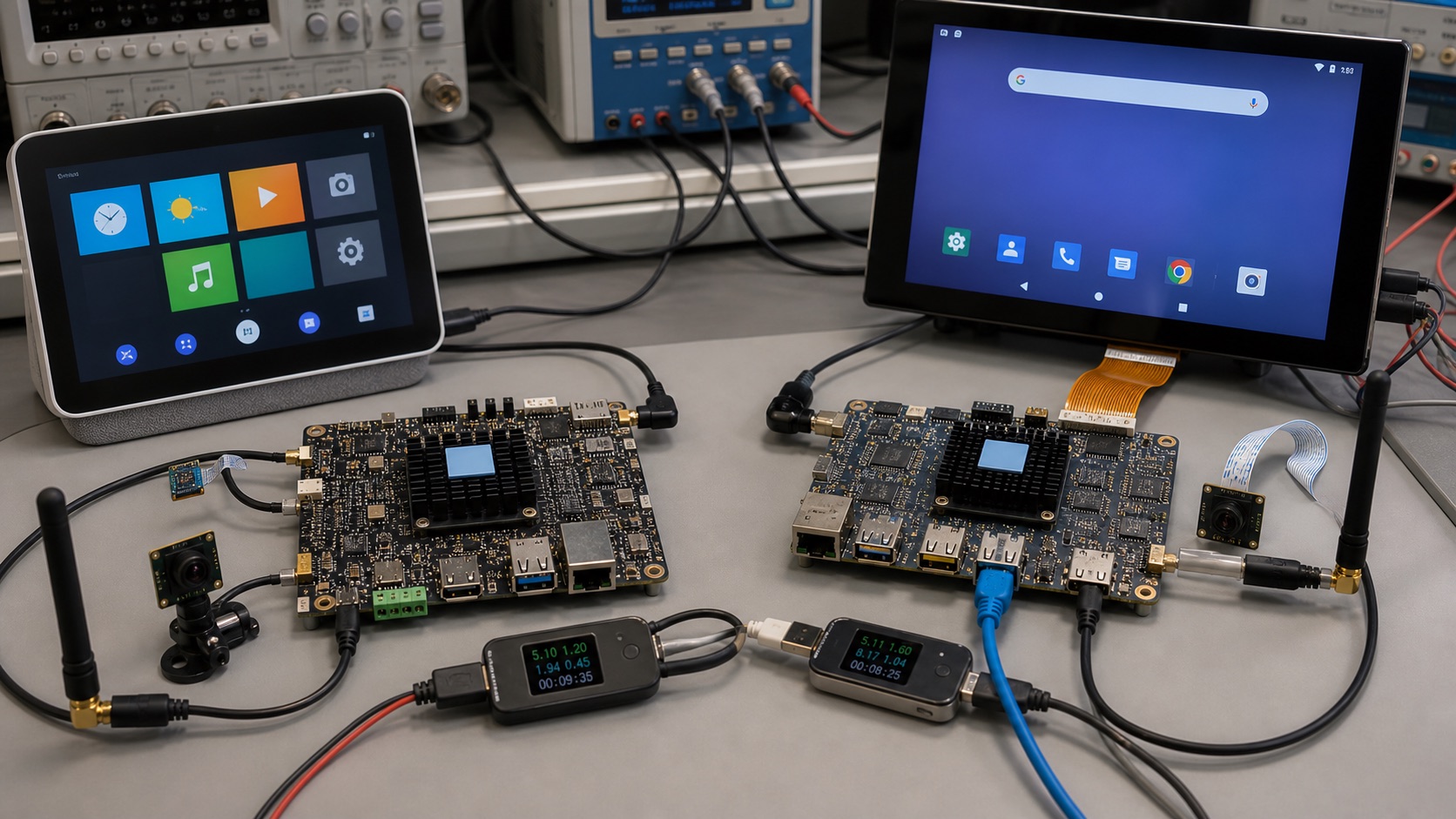
Quick Answer#
Choose MediaTek Genio when the product needs a smart-device-oriented AIoT platform with strong multimedia, camera, wireless, Android/Linux support paths, and a module partner ecosystem. Choose Rockchip when the product needs cost-effective Android/Linux SBC availability, broad board options, display flexibility, high compute choices, and faster access to development hardware.
Genio is often attractive for polished connected terminals, smart displays, AI cameras, and retail devices. Rockchip is often attractive for Android panels, HMI products, signage, edge AI boxes, and projects where board ecosystem and cost-performance dominate.
Decision Summary#
| Requirement | Better Starting Point | Why |
|---|---|---|
| Cost-effective Android panel | Rockchip | Broad SBC/SOM supply and display-oriented ecosystem |
| AIoT smart device with wireless | MediaTek Genio | Smart-device integration and Genio platform positioning |
| Fast board evaluation | Rockchip | Many boards and suppliers are easy to source |
| Module-backed commercial design | Depends | Genio and Rockchip both need supplier qualification |
| Camera-enabled retail terminal | Genio or Rockchip | Validate sensor, ISP, Android HAL, and AI runtime |
| High-performance edge AI box | Rockchip RK3588/RK3576 class | Strong compute and expansion options |
MediaTek Genio Strengths#
MediaTek Genio targets AIoT products such as smart displays, cameras, retail terminals, connected panels, HMI systems, and edge devices. Its value comes from MediaTek’s smart-device background: multimedia, camera, power management, AI acceleration, wireless ecosystem, and Android/Linux development paths.
Genio can be a strong choice when the product needs a polished smart-device experience and the team has access to a good module vendor. It is especially relevant when the product combines display, camera, audio, Wi-Fi/Bluetooth, AI, OTA, and cloud connectivity.
The main risk is supplier route. Teams should verify which Genio platform is available, which OS releases are maintained, which camera sensors and displays are validated, and who owns BSP changes during production.
Rockchip Strengths#
Rockchip is widely used in Android SBCs, Linux SBCs, smart panels, HMI devices, media players, edge AI systems, and custom embedded boards. The practical advantage is the ecosystem: many boards, modules, ODMs, and product examples exist.
Rockchip is often the faster route when a team needs to test an Android panel, Linux display product, signage player, or edge AI appliance. Platforms such as RK3566, RK3568, RK3576, and RK3588 cover a broad range from cost-sensitive panels to high-performance edge devices.
The risk is inconsistency. BSP quality, Android version, kernel maintenance, camera support, OTA tools, and thermal design vary significantly by supplier.
Software And BSP Comparison#
Genio projects should begin with the Genio developer ecosystem and the selected module vendor. Confirm Android, Yocto, Ubuntu-related paths where applicable, kernel, bootloader, AI runtime, display support, camera support, and update process.
Rockchip projects should begin with the board vendor BSP. Confirm whether the supplier can provide source, rebuild instructions, release notes, display/touch patches, camera drivers, NPU tools, OTA, recovery, and production flashing.
In both cases, a booting demo image is not enough. The real decision is which supplier can support the exact board and product configuration.
Cost, Availability, And Product Positioning#
Rockchip often wins early shortlist discussions because development boards and modules are easy to find and cost-performance is clear. This is valuable for fast prototyping, Android panels, signage devices, and edge boxes. The risk is that low-cost boards may not include the BSP discipline, lifecycle commitment, or production support needed for commercial equipment.
MediaTek Genio may look more supplier-dependent, but that can be a strength when the module partner provides a polished platform with validated wireless, display, camera, AI runtime, and production tools. Genio should not be evaluated only by chip price; evaluate the complete module and support package.
Camera, AI, And Wireless Workloads#
If the product has a camera, local AI, and wireless connectivity, Genio deserves serious evaluation. If the product is a display-first Android panel with Ethernet and standard peripherals, Rockchip may be faster and cheaper. If the product needs heavy edge AI and expansion, RK3588 or RK3576-class boards may provide more headroom than smaller Genio platforms.
The final decision should use measured latency, camera quality, UI smoothness, power draw, thermal behavior, OTA behavior, and supplier response time.
Supplier Bake-Off Method#
Ask one Genio supplier and one Rockchip supplier to support the same short proof of concept: boot image, display, touch, camera, network, one AI model, OTA trial, and a two-hour thermal run. Track how many issues are solved by documentation, how many require private patches, and how quickly the supplier responds.
For many commercial products, that support evidence is more predictive than small differences in CPU, GPU, or NPU specifications.
Keep the proof-of-concept image, test logs, supplier tickets, and thermal notes. They become the evidence base for the final platform decision.
Without that record, later cost, support, sourcing, maintenance, and lifecycle discussions become guesswork instead of engineering review.
Product Fit Table#
| Product Type | MediaTek Genio Fit | Rockchip Fit |
|---|---|---|
| Android smart display | Strong | Strong |
| Low-cost HMI | Selective | Strong |
| AI camera | Strong when sensor path is supported | Strong when ISP/NPU path is validated |
| Smart retail terminal | Strong | Good |
| Edge AI box | Good | Strong, especially higher-end RK platforms |
| Industrial Linux gateway | Selective | Selective; compare NXP/TI for lifecycle |
| Wireless-first device | Often stronger | Board/module dependent |
Validation Priorities#
For Genio, validate module availability, OS release maturity, camera sensor support, AI runtime, wireless certification path, and support channel. For Rockchip, validate board vendor quality, Android/Linux BSP, display interfaces, camera path, NPU tools, update strategy, and thermal behavior.
Both platforms require real workload testing. Run the final UI, final camera, final AI model, network traffic, OTA process, and enclosure thermal test before hardware freeze.
Recommendation#
Start with Rockchip when cost, board availability, display flexibility, and fast Android/Linux evaluation are the main goals. Start with MediaTek Genio when the product is a connected smart device and the supplier can provide a strong Genio module, BSP, wireless path, and camera/AI support.
Do not frame the decision as MTK versus Rockchip only. Frame it as supplier-supported product architecture versus integration risk.
FAQ#
Is MediaTek Genio better than Rockchip for Android?
Not universally. Genio may be stronger for smart connected devices; Rockchip is often simpler and more cost-effective for Android panels.
Which is better for edge AI?
Rockchip high-end platforms can be strong for edge AI boxes. Genio is attractive when AI is part of a connected display, camera, or retail terminal.
Which has better BSP support?
It depends on the module or board vendor. Always evaluate the exact BSP, not only the SoC family.