Qualcomm QCS8550 Guide for Edge AI and Robotics#
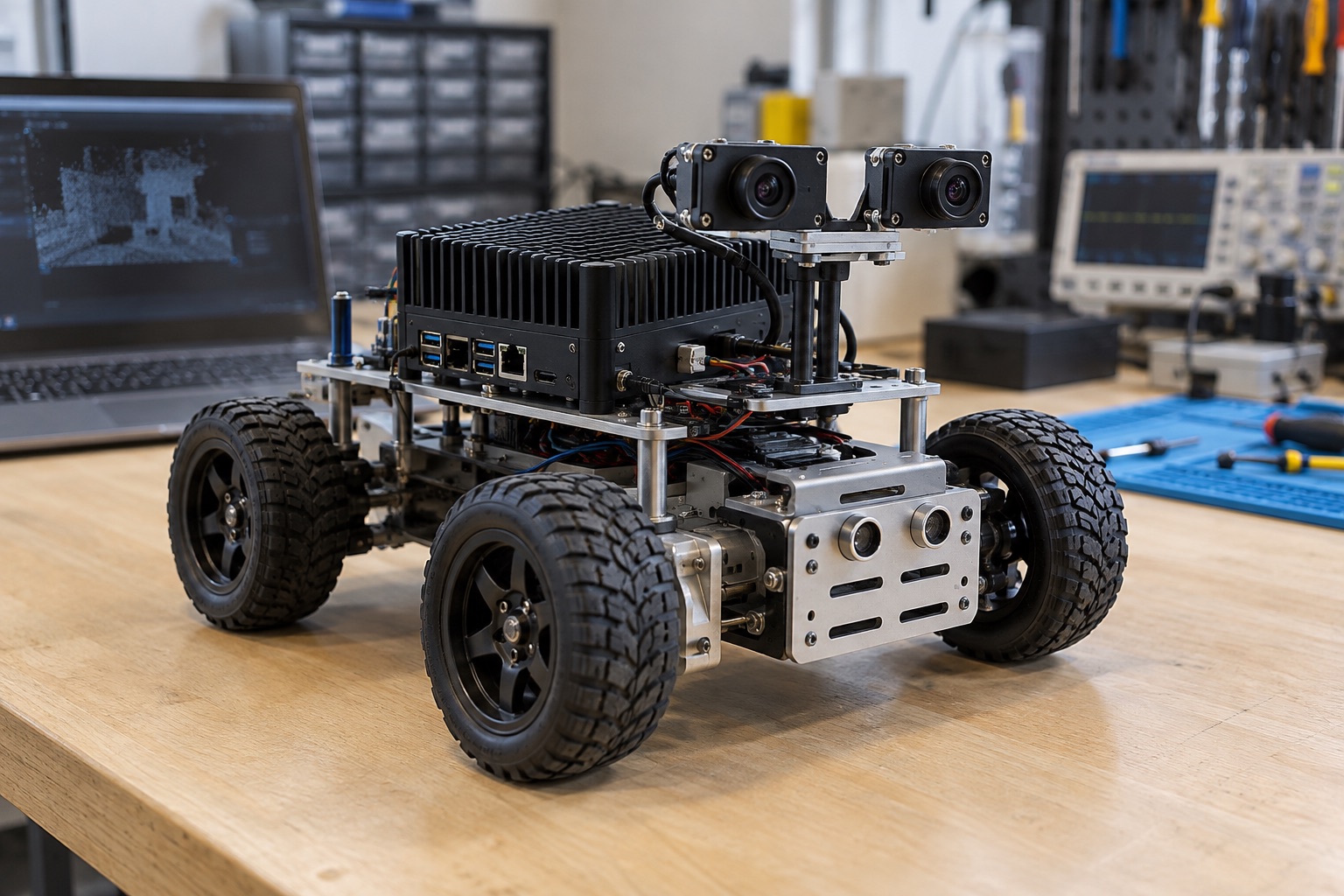
AI-generated application illustration; not a photograph of a verified QCS8550 robot or benchmark platform.
Quick Answer#
Qualcomm Dragonwing QCS8550 is a premium IoT processor to evaluate for demanding camera, graphics, and edge-AI applications. Qualcomm lists Kryo application processing, Adreno graphics, and Hexagon acceleration; its current product page advertises 48 dense TOPS. That figure is a vendor specification, not a measurement of your model or complete robot. See the official QCS8550 page.
The platform makes sense when concurrent workloads justify its integration cost and the supplier can deliver the required BSP, camera support, and accelerator runtime. This article provides an evaluation framework rather than a hands-on performance ranking. Do not infer cellular connectivity, certification, or software access from the processor name alone.
Define The Complete Edge Workload#
A robot may capture multiple streams, estimate its surroundings, render a local interface, communicate with a host, and record diagnostics. Each task competes for memory traffic and processing resources. Define which operations must run together, their deadlines, and the behavior allowed when resources become constrained.
Separate perception from actuation. A powerful application processor can still suffer scheduling delays, driver faults, or model failures. Determine which subsystem owns time-critical control and what happens when perception data becomes stale. This is an architectural requirement, not a conclusion that follows from an AI throughput number.
| Product Direction | Potential Reason To Evaluate | First Proof Required |
|---|---|---|
| Multi-camera robot | Concurrent perception and application work | End-to-end latency under motion |
| Intelligent camera appliance | Image processing plus local analysis | Sensor support and model accuracy |
| Premium interactive terminal | Graphics, camera, audio, and AI together | Stable combined user experience |
| Small sensor gateway | Often excessive resources | Clear benefit over a simpler platform |
| Offline AI appliance | Local processing requirement | Model fit, memory, and sustained operation |
The table is an editorial recommendation about evaluation priorities. It does not assert that every QCS8550 module supports every camera, operating system, or wireless configuration.
Convert The Actual Model Early#
Begin with a representative production model rather than a convenient demonstration model. Confirm conversion support, operator coverage, precision requirements, and runtime compatibility. Capture any portions that fall back to another processor. A model that loads successfully may still use the accelerator differently from what the team expects.
Preserve the export script, model hash, conversion options, and calibration dataset where applicable. These artifacts are essential when comparing runtime versions. A later performance change may come from graph transformation or numeric behavior rather than the hardware itself. Version the entire deployment path, not just the original training file.
Measure accuracy after conversion. Quantization or substituted operations can change borderline results, especially with unusual illumination or small objects. Report the task-specific metric and its evaluation dataset beside latency. Faster inference is not a product improvement if it misses the events the device exists to detect.
Treat TOPS As A Starting Point#
The advertised 48 dense TOPS does not translate directly into frames per second. Model structure, tensor dimensions, supported operations, memory access, and software scheduling determine delivered performance. Comparisons across vendors also need compatible arithmetic assumptions and test conditions. Read the AI performance guide before using headline figures as a ranking.
Record both isolated inference and complete pipeline timing. Include capture, preprocessing, transfers, postprocessing, and result delivery. If a workload batches inputs, state the batch size and latency cost. High throughput can coexist with unacceptable response delay for interactive or moving systems.
Track distributions rather than only the best run. Tail latency and missed deadlines matter when decisions affect a changing environment. Retain warm-up behavior, sustained results, and thermal state. A short benchmark from an idle board cannot establish a robot’s behavior during a long operating shift.
Camera Support Is More Than A Connector#
Ask for the exact sensor and operating mode supported by the module vendor. Confirm driver availability, tuning ownership, exposure control, synchronization, and timestamp semantics. A camera that produces images may still be unsuitable for the intended perception algorithm because frame timing or image quality is inconsistent.
Evaluate difficult inputs early: motion blur, low light, glare, rolling-shutter effects, and partially obscured subjects. Store source frames before preprocessing so the team can distinguish optical failures from model failures. More compute cannot recover information that the sensor never captured.
For multiple cameras, test concurrent operation at the required settings. Independent sensor demonstrations do not establish aggregate bandwidth or synchronization. Record the complete topology, including bridges and cables, because these details affect reliability and can change with a carrier revision.
Negotiate Software Access Before Hardware Freeze#
Request the available operating systems, release versions, kernel baseline, build process, and source-access terms from the chosen supplier. Public product positioning does not prove that a specific Linux or Android image supports every required peripheral. Establish which party fixes camera, graphics, networking, and runtime integration defects.
Make a clean rebuild and deployment part of supplier acceptance. Identify licensed binaries, restricted documentation, and tools that need separate access. Clarify whether those rights extend to manufacturing and long-term maintenance. Discovering an access dependency after committing custom hardware can block the entire release schedule.
Document the update relationship between the OS, accelerator runtime, application, and models. A runtime update may require reconversion or requalification of model artifacts. Stage changes so an incompatible combination cannot be installed accidentally, and keep a tested route back to a usable release.
Evaluate Power In The Real Robot#
Measure the system at its intended power input with cameras, storage, wireless components, and cooling active. Peak processor specifications do not establish battery endurance. Motor noise and supply transients can also affect compute stability, so qualification should include the electrical environment of the moving platform.
Run sustained perception while recording diagnostics and exchanging network traffic. Observe throttling, frame drops, temperature, and latency. A cooling arrangement that works on an open bench may be impractical in a sealed enclosure or vulnerable to dust. Include maintenance and acoustic constraints when selecting a fan or passive solution.
Define degraded behavior under thermal or power limits. The application might reduce a nonessential stream or report reduced capability, but the choice should be deliberate. Silent reductions that invalidate model assumptions can be more damaging than a clearly reported unavailable feature.
Compare Against Smaller Platforms#
Compare QCS6490 when a lower workload may satisfy the product, and QCS8250 when an existing software investment is relevant. Avoid declaring QCS8550 the winner before evaluating migration effort, availability, and supplier support.
For cross-vendor comparisons, use the same input data, model, precision, output requirements, and enclosure constraints. Include engineering effort and field maintenance in the decision. The cheapest board and the highest theoretical accelerator figure are both incomplete measures of total product suitability.
Release Evidence To Retain#
| Area | Required Record |
|---|---|
| AI | Model, export settings, runtime, accuracy and latency distribution |
| Cameras | Sensors, modes, synchronization and image-quality conditions |
| Thermal | Enclosure, cooling, ambient conditions and sustained behavior |
| Software | BSP manifest, access rights, update compatibility and ownership |
| Recovery | Sensor loss, power interruption, application restart and rollback |
Review this evidence with both application and hardware owners. Missing camera tuning or update responsibility is a real platform limitation even if raw compute is sufficient. Approval should describe what has been demonstrated and which operating assumptions the product depends on.
FAQ#
Does 48 TOPS mean a model will run at a predictable frame rate? No. The vendor figure describes theoretical arithmetic capability under its stated basis. Measure the actual model and complete pipeline.
Does QCS8550 automatically include the connectivity my product needs? No. Confirm the selected module, companion components, antennas, software, and approvals. Do not infer the finished system’s connectivity from family-level marketing.
Can QCS8550 replace a dedicated real-time controller? Only after the complete architecture meets its timing and failure requirements. Application compute performance alone is insufficient evidence.
Sources And Editorial Basis#
Reviewed September 18, 2026. Naming and accelerator facts follow the linked Qualcomm product page; its IoT introduction provides historical positioning. Evaluation procedures are editorial analysis, not laboratory results. See the Qualcomm overview and editorial policy.