Best Processors for Compact PLCs and Industrial Controllers#
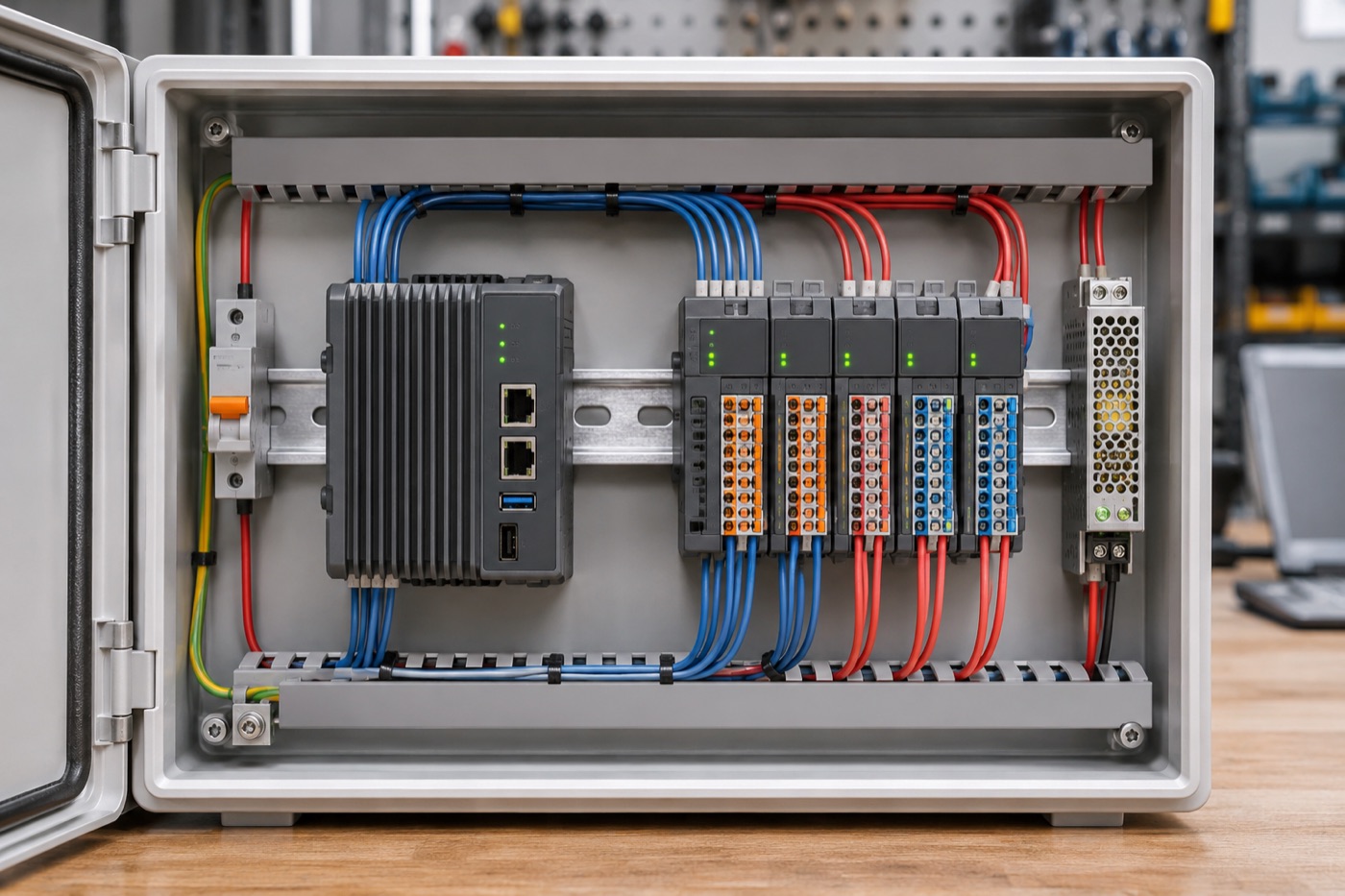
AI-generated engineering illustration.
Give The Control Loop A Clear Owner#
Start with an industrial MCU such as TI AM243x for a compact controller whose essential work is cyclic I/O and industrial communications. Evaluate a heterogeneous MPU such as TI AM64x when the product also needs substantial Linux services and the relevant MCU or real-time domain can own the control deadlines. A discrete control MCU paired with a Linux processor is worth pricing when the team needs independent reset behavior or wants to reuse a trusted controller.
Choose from the actual workload. List the sensor sampling period, maximum time from input to output, allowed jitter, communications role, behavior after a lost peer, and maximum startup delay. Put application updates and diagnostics on the same sheet. A processor that can run the web interface and control algorithm at the same time still needs a design that specifies where time-critical work executes.
Price An Architecture Before A Part Number#
| Workload | Architecture to evaluate | Acceptance evidence |
|---|---|---|
| Cyclic digital I/O with a local configuration interface | MCU with qualified I/O and communications stack | End-to-end input-to-output delay, watchdog response, and startup behavior |
| Networked controller with web UI, logging and remote service | Heterogeneous MPU with control assigned to a timing-qualified domain | Control timing under Linux load and predictably bounded behavior during updates or faults |
| Independent controller plus a rich panel or gateway | MCU and Linux MPU with a versioned protocol between them | Reset isolation, protocol compatibility across versions, and recovery after loss of either side |
The TI AM243x real-time industrial controller guide is useful when the control side can do its job without Linux. Compare it with the TI AM64x industrial processor guide when combining Linux and industrial communications. An i.MX93 Linux platform may be a candidate for the service side of a two-processor design if the board and BSP meet the product requirements.
State The Industrial Network Role#
Write the exact network role into the specification. Running an EtherCAT slave device and running an EtherCAT master require different software and verification. Certification or conformance expectations depend on the selected protocol and role. Ask suppliers for evidence for the chip, interface block, SDK version and example you will actually evaluate. TI describes supported combinations in Industrial Communication Protocol Support for Arm-based Microcontrollers and Processors and in the corresponding SDK documentation.
An Ethernet MAC and a connector establish basic connectivity. The implementation still needs the correct stack, hardware configuration, clocks, and any licensed components. Check the selected PHY, board wiring, timing options, and SDK licensing terms before assuming a reference example can be shipped. The industrial Ethernet, CAN, and RS485 interface guide is useful for checking the rest of the board-level communications design.
Make space in the schedule for interoperability testing with the actual supervisor, network configuration, and field devices. Exercise a node restart, link interruption, and communications timeout. Define what the control domain does until a valid command sequence returns. Operators should be able to distinguish a field network fault from a healthy network with an unavailable Linux interface.
Bound The Work Between Domains#
For a heterogeneous design, keep the boundary small and versioned. A common partition gives the control domain ownership of scan timing, I/O, and timeout behavior, while Linux handles asset configuration, analytics, and remote service. Define which messages may change active parameters and when the change takes effect. Include freshness or sequence information if stale data could otherwise be mistaken for a current command.
Shared memory and interrupts can simplify data exchange while introducing dependencies on bus traffic, cache behavior, and reset ordering. Budget for the worst expected data transfer and bound the queues. Give a full queue a defined result. A slow logger or disconnected reporting client should not unexpectedly block a control task. Test the behavior across reboots and after software on one side is updated.
A discrete MCU often makes the reset and failure boundary easier to observe. It introduces another firmware image, another interface, and additional manufacturing checks. Use a controller-to-host protocol that supports compatibility checks and reports useful versions so a replacement module can be serviced. A clear division also helps the team isolate whether a field problem belongs to an I/O fault, the network, or application software.
Measure The Deadline Where It Matters#
A scheduler statistic is informative, but an input-to-output trace tests the system. Use representative I/O, a repeatable stimulus, and suitable timing instrumentation on a controlled bench. Record the distribution and worst observed delays while Linux performs representative networking, storage writes, and user-interface activity. Run cold and warm starts and long enough to exercise normal periodic workloads. Record failures and inferred limits separately from what was actually observed.
Define a test set for fieldbus reconnects, control task restart, invalid configuration, and independent Linux reboot. For each, write the expected output state and who is allowed to restore operation. Where the equipment has safety functions, use its formal safety engineering and validation process. Selecting an industrial communication stack or a processor with a real-time core does not establish functional safety.
Keep a time base for the measurements. For example, tag the input event and actuator command with the controller’s cycle counter and capture the relevant electrical transitions on the same instrument. This lets the team distinguish time spent waiting for the next scan from time spent moving data through the network or output circuitry. If an overload causes a missed cycle, record the configured fallback behavior and confirm that the supervision and diagnostic systems report the incident.
Procurement Sign-Off#
Ask for the exact SoC order code, module and PHY revisions, SDK sources and versions, stack licensing terms, and evidence for the required protocol role. Require a reproducible build and an ownership chart for both firmware and Linux maintenance. The mainline and vendor Linux kernel guide can help assess the service side. Use the industrial Linux gateway selection guide if the main product requirement is protocol translation and remote data capture.
FAQ#
Is Linux with PREEMPT_RT enough for a compact controller?
Evaluate it against the exact deadline, drivers, and workload. Use measured end-to-end timing and a defined failure response. A tight or independently supervised control loop can justify a separate real-time domain.
When is an MCU-only PLC the better starting point?
It is often the simpler starting point when cyclic control, a qualified network stack, local configuration, and modest diagnostics cover the product. Price the Linux path when a specific application need justifies it.
Source Notes#
Reviewed November 23, 2026. Primary references include TI’s AM64x and AM243x Technical Reference Manual Rev. K, Industrial Communication Protocol Support for Arm-based Microcontrollers and Processors, and the AM64x MCU+ SDK Industrial Communications Toolkit documentation. The architecture and test recommendations are editorial analysis, with timing and safety qualification left to the product team.