ESP-IDF Guide to Secure Boot and Reliable OTA#
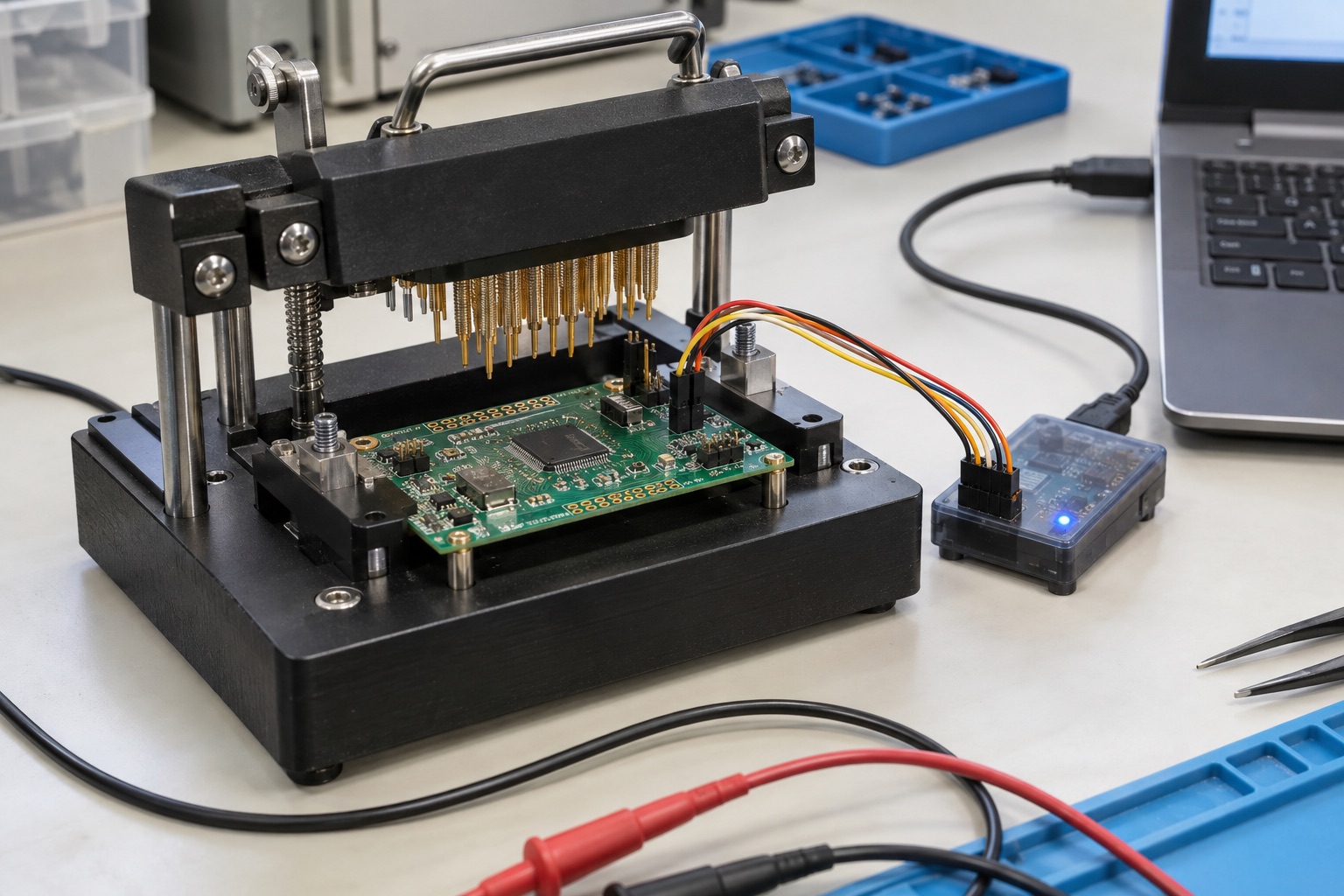
AI-generated manufacturing illustration; not evidence of a completed production security audit.
Quick Answer#
A production ESP32 release needs more than an application that builds successfully. Establish a reproducible ESP-IDF baseline, a documented partition layout, controlled device provisioning, authenticated firmware, and a tested recovery path. Secure boot, flash encryption, encrypted transport, and OTA rollback solve different problems and should be designed together.
There is no safe universal fuse-burning recipe for the whole ESP32 family. Chip revision, SDK release, boot scheme, and service policy matter. This guide explains the decisions and evidence needed before irreversible provisioning. It is an engineering workflow, not a claim that the site has tested your board or audited your security design.
Pin A Reproducible Development Baseline#
Record the ESP-IDF release, target, toolchain, component versions, configuration defaults, partition table, and build instructions. Store the application source revision alongside a hash of each released binary. A colleague should be able to reproduce the intended release without searching a developer’s machine for an undocumented package or configuration change.
Separate development credentials from production identity and signing material. Test automation should not require access to production private keys. Define a controlled signing stage and retain enough metadata to determine which approved source and configuration produced an artifact. Reproducibility and authenticity are complementary; neither alone proves the application is correct.
Select the documentation for the exact target and release. The ESP-IDF programming guide is a useful entry point, but its stable alias can change. Archive the release-specific links used for qualification so future maintainers can distinguish the shipped baseline from newer instructions.
Give Each Security Control A Purpose#
| Control | Primary Purpose | Does Not Replace |
|---|---|---|
| Secure boot | Verify authorized executable images | Application correctness or vulnerability fixes |
| Flash encryption | Protect supported stored content | Signature verification and access control |
| TLS transport | Protect communication with authenticated peers | Boot-time firmware authenticity |
| OTA rollback | Recover from an unsuccessful trial image | Prevention of deliberate version downgrade |
| Anti-rollback | Enforce a minimum security version | Functional health checks |
| Unique identity | Distinguish and authorize devices | Firmware signing and key protection |
Review implementation details in the C3 security overview or the equivalent page for your target. Features with similar names can have different constraints across chips. The table explains design intent; it is not a promise that every configuration supports every mechanism identically.
Review Advisories Before Provisioning#
Silicon security claims require revision-specific review. Espressif’s AR2026-006 advisory documents an ECDSA boot-verification issue on specified products and revisions. Do not assume an SDK upgrade alone repairs an affected ROM verification path. Follow the advisory’s target-specific countermeasures and consult Espressif for migration of already-provisioned devices.
Maintain a release record connecting the device revision, selected boot scheme, and advisory assessment. Recheck that record when purchasing substitutes or changing firmware security options. A generic statement that the product uses secure boot is less useful than evidence that the selected implementation addresses the relevant threat model.
Design Partitions For Future Releases#
Allocate update slots using the expected production image plus identified growth. Include persistent configuration, provisioning data, logs, and assets separately. An image fitting today does not establish that the next certificate bundle or feature release will fit. Keep the layout in version control and validate binary size during each release build.
Plan how data survives firmware rollback. A new application may change a settings format before discovering a failure. If the old image cannot read the modified data, booting it is not meaningful recovery. Use backward-compatible changes or a deliberate migration strategy, and test the application and data state together.
Partition changes deserve special treatment because the deployed layout already constrains updates. Do not assume that downloading a new application automatically migrates bootloader, table, and data safely. Define a supported upgrade path for each starting layout, or explicitly retain the earlier layout for the lifetime of that hardware revision.
Make First-Boot Validation Meaningful#
ESP-IDF’s OTA documentation describes trial-image states and application confirmation through functions such as esp_ota_mark_app_valid_cancel_rollback(). With rollback configured appropriately, the application should confirm the new image only after its required health checks succeed.
Choose checks that indicate local fitness to run: settings readability, required peripheral initialization, and essential task progress. Depending exclusively on cloud reachability can reject good firmware during a network outage. Conversely, confirming immediately on entry can accept an image that fails moments later when the real application starts.
Keep diagnostics short enough to avoid unnecessary disruption but broad enough to catch critical regressions. Define what the device does if it repeatedly fails trial boots. The service team should know whether it returns to a previous version, waits for a new update, or requires a documented recovery procedure.
Keep Rollback And Anti-Rollback Distinct#
Functional rollback helps recover from a broken release. Anti-rollback prevents execution below an allowed security version. These objectives can conflict if a security version is advanced before a usable recovery image is available. Model the permitted version transitions before provisioning or enabling a campaign.
Use explicit examples in the release plan. Suppose version B replaces vulnerable version A but fails a sensor initialization check. Decide in advance whether A remains allowed, whether another fixed image is available, and how service proceeds if neither boots. The correct answer depends on the product’s risk and recovery requirements.
Treat Provisioning As A Controlled Transaction#
Define the order for device identification, application flashing, functional checks, credential installation, and final security configuration. Some settings are irreversible, so qualify the sequence on sacrificial units and verify the resulting state. Interrupted factory operations need clear restart rules that do not duplicate identities or leave ambiguous records.
Keep private material out of routine test logs and operator screens. Separate access to signing infrastructure from ordinary firmware development. Record success, identifiers, and artifact hashes where appropriate, while limiting access to secrets. Design the audit trail so a returned device can be traced without exposing its credentials.
Service policy must match production state. A support guide that assumes unrestricted debugging is unusable after debugging has been disabled. Determine which diagnostics remain available, what a factory reset erases, and when replacement is preferable to rework. Validate these decisions before closing the enclosure design.
Test Interrupted Updates Systematically#
| Interruption Or Failure | Expected Evidence |
|---|---|
| Network loss during download | Existing application remains usable |
| Power loss during image write | Defined boot outcome without partial execution |
| Invalid or incompatible image | Rejection with actionable diagnostics |
| New application fails health checks | Tested rollback or documented recovery |
| Settings migration fails | Recoverable application and data state |
| Device misses several releases | Supported upgrade path from older firmware |
For each test, record the starting version, exact interruption stage, resulting boot state, and customer-visible behavior. Repeat with production security settings rather than relying solely on development units. A test that bypasses signature or encryption behavior does not qualify the configuration shipped to customers.
Roll Out In Observable Stages#
Begin with an internal cohort, then a limited field cohort before broad deployment. Track installation success, boot health, application failures, and recovery outcomes separately. A completed download is not a successful upgrade. Define campaign stop conditions and retain an operational owner who can respond when failure rates exceed them.
Avoid deploying solely by a marketing model name. Match hardware revision, memory layout, and compatible starting versions. Devices offline for months may return with old credentials and data formats. Support those transitions deliberately, and maintain a clear end-of-support policy when an upgrade path can no longer be provided.
FAQ#
Does HTTPS OTA make secure boot unnecessary? No. Transport protection and boot-time image authorization cover different stages. Choose both according to the product threat model and target capabilities.
Can every ESP32 use the same security configuration? No. Use target- and revision-specific documentation, and check relevant advisories before provisioning irreversible settings.
Does a successful rollback prove recovery is complete? Only if the restored application also works with retained settings, assets, credentials, and peripherals. Verify usable behavior rather than merely observing a boot message.
Sources And Related Guides#
Reviewed September 18, 2026. Linked ESP-IDF documents and advisory provide implementation authority; release workflows and test criteria are editorial recommendations. See general secure boot and OTA guidance, ESP32 selection, and the Espressif overview.