ESP32-P4 Guide: Touchscreen HMI, Camera Pipelines, and Companion Wi-Fi#
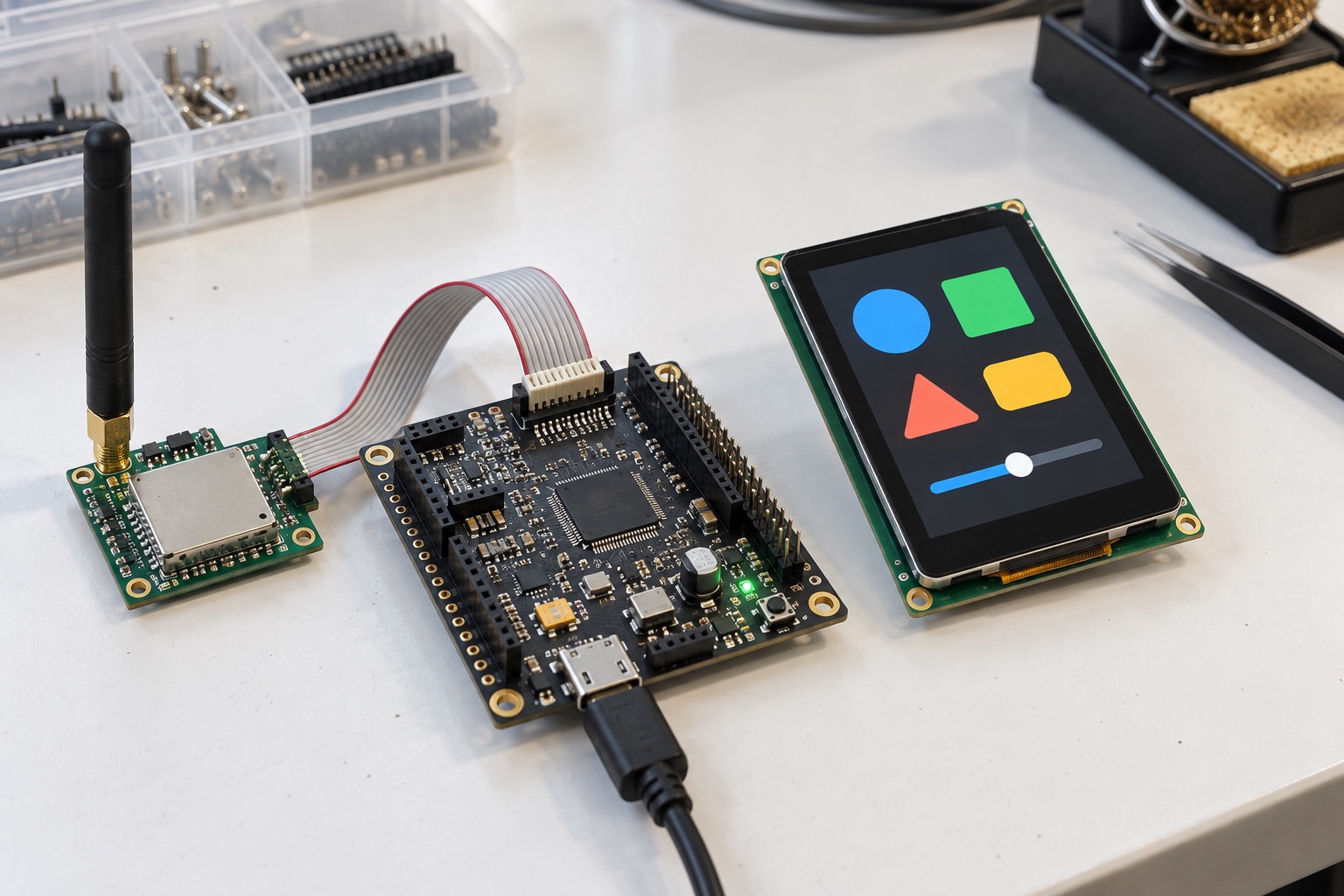
AI-generated engineering illustration, not a verified ESP32-P4 board photograph or a measured test setup.
Quick Answer#
ESP32-P4 is a candidate for MCU-based interfaces and multimedia products that need more local processing and peripheral capability than a simple connected sensor. It is not a conventional Linux application processor, and it does not include native Wi-Fi or Bluetooth. A wireless product therefore needs a companion device or another external connectivity path.
Evaluate the complete architecture: display buffers, application memory, camera processing, companion communication, and coordinated updates. This guide uses official documentation and engineering analysis, not measured display frame rates or claimed hands-on experience with a particular development board.
Understand The Product Category#
Espressif’s ESP32-P4 product page describes a RISC-V MCU platform aimed at richer embedded interfaces and multimedia workloads. Its development model remains firmware-oriented. Linux packages, browser engines, and container workloads cannot be assumed to transfer unchanged.
The ESP-IDF getting-started documentation explains the need for an external wireless SoC when Wi-Fi or Bluetooth is required. A development board may include that companion, which can make a board-level feature look like a native P4 function.
Specify the exact board and module arrangement. Record chip revision, external memory, flash capacity, display, camera sensor, companion device, and firmware releases. These details determine whether a demonstration can become a reproducible product configuration.
Start With The Interface Workload#
Define screen resolution, color format, update rate, touch behavior, and the most demanding view. Include fonts, charts, image assets, and transitions. A static menu is not representative of a panel that continuously renders camera previews or rapidly changing data.
Calculate framebuffer memory explicitly. Width times height times bytes per pixel gives a basic buffer size; multiple buffers, alignment, working surfaces, and graphics-library allocations add to it. For example, an 800 by 480 RGB565 buffer occupies 768,000 bytes before those additional allocations.
Measure input-to-feedback latency while the rest of the application is active. A panel can achieve an attractive frame rate yet respond poorly to touch because networking or storage blocks a critical task. Keep UI operations bounded and avoid performing long transactions directly in event handlers.
Budget Internal And External Memory Separately#
Not every allocation has identical access, timing, or DMA requirements. Identify which buffers and stacks must reside in particular memory regions. External RAM capacity should not be treated as interchangeable with all internal resources.
Track peak allocations during startup, image decoding, network handshakes, and updates. These peaks may not occur during normal steady operation. Preserve enough margin for the largest combination of required activities rather than sizing from a quiet home screen.
| Allocation | Planning Input | Stress Test |
|---|---|---|
| Display buffers | Resolution, format, buffer count | Rapid full-screen changes |
| Camera buffers | Sensor mode and queued frames | Preview plus processing |
| Network data | Transport and encryption settings | Reconnect during UI activity |
| Application | Task stacks and dynamic objects | Largest supported workflow |
| Update storage | Images, assets, rollback policy | Interrupted release installation |
Inspect the largest available free block as well as total free memory. Fragmentation can cause an allocation failure even when the total appears sufficient. Repeatedly enter and leave complex views to expose leaks that a single startup test misses.
Design The Companion Wireless Link#
Choose a supported host-companion arrangement and transport based on the actual application. Espressif documents wireless connectivity options for ESP32-P4. Confirm the relevant component versions and target support instead of assuming every example uses the same architecture.
Treat the connection as a real interface with bandwidth, buffering, reset, and compatibility constraints. Decide which side owns credentials, connection state, and diagnostics. A companion reset must not leave the host waiting indefinitely for a response that can no longer arrive.
Test reconnects while rendering, acquiring camera data, and writing storage. The companion may offload radio work while the host still handles substantial application processing. Measure end-to-end throughput and responsiveness rather than quoting only the wireless link’s nominal rate.
Validate Camera Processing As A Pipeline#
Confirm the exact sensor, interface, driver, and image-processing path. Sensor support on one development board does not prove compatibility with an arbitrary replacement. Lens, exposure, and illumination also affect whether the captured data is useful.
Map capture, conversion, scaling, display, encoding, or inference stages as required. Count copies and queued buffers. A camera preview that works alone may exceed memory or timing limits when combined with a full interface and network upload.
Define a frame-dropping policy when consumers cannot keep up. Many interactive products benefit more from a current frame than from processing every old frame. Make the policy observable through counters so performance problems do not remain hidden.
Review Security Against The Actual Chip Revision#
Espressif’s AR2026-006 advisory, version 1.1 dated July 28, 2026, includes ESP32-P4 revisions through v3.2 in an ECDSA secure-boot issue. Check the advisory against purchased silicon and the intended boot configuration; do not assume a general SDK update resolves a ROM issue.
More broadly, document signing keys, device identities, recovery authorization, and production provisioning. Test irreversible settings on sacrificial units before manufacturing. Security mechanisms need an operational process that matches the actual hardware and service policy.
The companion firmware belongs in this review too. Define how its authenticity is checked and how incompatible host-companion combinations are prevented. A secure host does not automatically establish trust in every external device or transport path.
Coordinate Releases And Recovery#
Version host firmware, companion firmware, interface assets, and persistent configuration as a tested set. Define supported combinations and migration rules. An update that changes the display assets or communication protocol can fail even when both processors boot normally.
Test interruption at every meaningful installation boundary. The system should retain a compatible release or enter a documented recovery state. Verify rollback with real configuration data rather than only with a freshly erased development board.
Factory testing should cover display, touch, camera, communications, storage, and power transitions. Record firmware hashes and chip revisions with each unit. That traceability makes later advisory reviews and field diagnosis substantially more reliable.
FAQ#
Does ESP32-P4 have built-in Wi-Fi? No. Wireless-enabled boards use an additional device or another external connectivity arrangement. Check the complete board design rather than attributing all board features to the P4 chip.
Can ESP32-P4 replace a Linux HMI board directly? Not directly. It is an MCU platform with a different software and memory model. It can suit a bounded interface that is implemented for that environment.
What is the highest-risk integration test? Run the real interface, camera workload, wireless reconnects, and update activity together. This exposes memory peaks and cross-device recovery problems that isolated examples miss.
Sources And Related Guides#
Compare the ESP32-C5 companion option, ESP32 family selection guide, and display interface overview when defining the complete panel architecture.
Reviewed October 27, 2026 using Espressif’s product, software, and advisory documentation linked above. No measured performance is claimed. See the ESP32-S3 guide and ESP-IDF security and OTA guide for related decisions.