Amlogic S905D3 Guide: Audio, Media, and Small Edge AI Appliances#
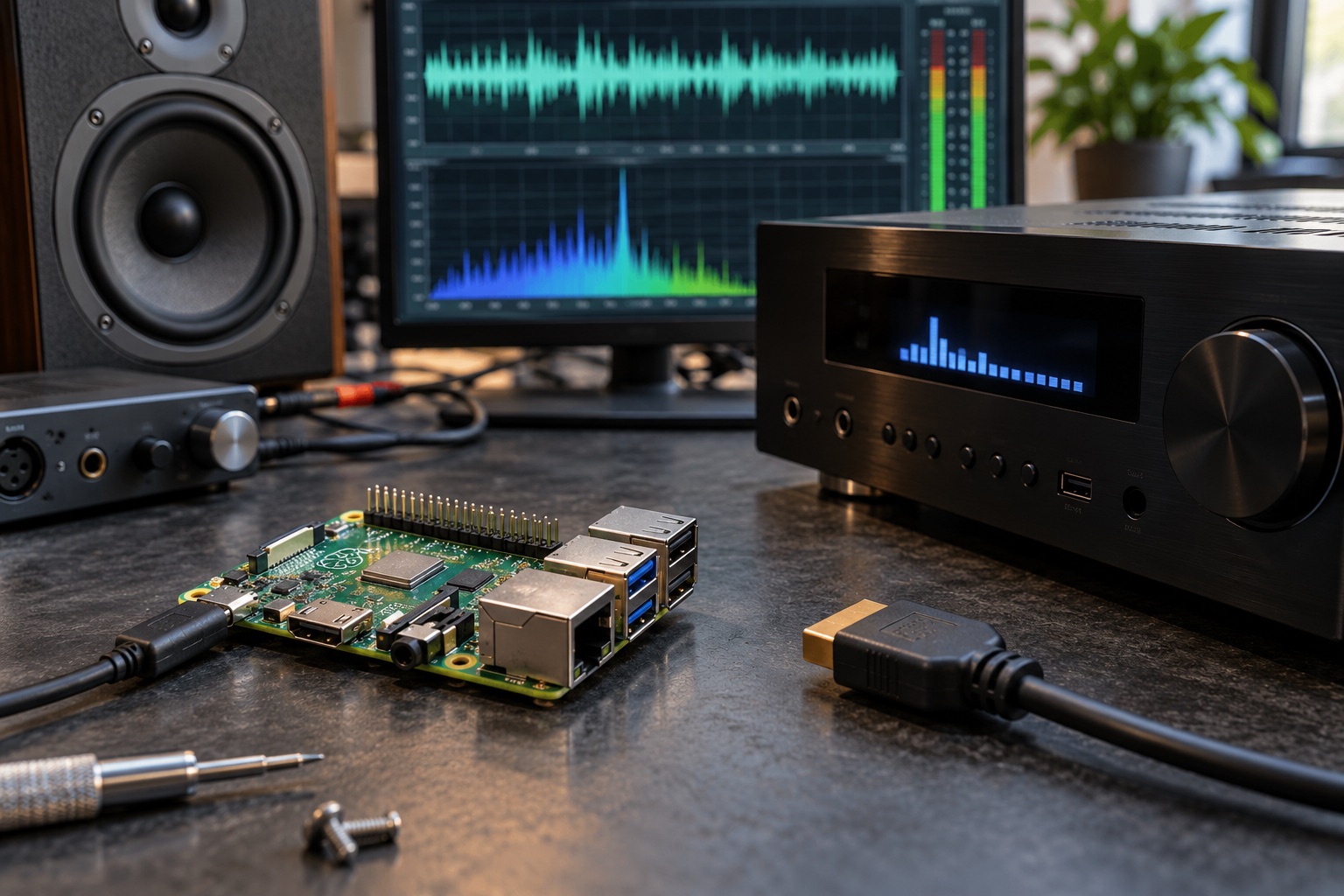
AI-generated engineering illustration, not a verified S905D3 board photograph or a measured test setup.
Quick Answer#
S905D3 is worth examining for compact media and audio appliances when a supported board already provides the required interfaces and software. Evaluate its optional AI use through the available model toolchain, not merely an accelerator headline. For a new product, maintenance and supply evidence may be more decisive than the raw specification of an established platform.
Khadas VIM3L provides a documented implementation that helps make the assessment concrete. It must not be confused with VIM3, which uses a different processor. This guide is based on public documentation and engineering reasoning, not independent audio, video, or inference measurements.
Keep VIM3L And VIM3 Distinct#
The Khadas VIM3 family documentation and VIM3L specification identify VIM3L as an S905D3-based board with quad-core Cortex-A55 processing. Khadas lists a 1.2 TOPS NPU for this implementation. VIM3 specifications should not be substituted for VIM3L capabilities.
Record the exact board revision, memory, storage, power accessories, and image version. Similar product names can lead to incorrect downloads or mistaken expectations about acceleration. Verify the board identity before flashing firmware or applying device-tree changes.
Use board documentation to establish exposed interfaces and supported accessories. A processor datasheet describes silicon options; it does not prove that every signal is available on a convenient connector. Confirm electrical compatibility and required drivers for each external device.
Define The Appliance’s Primary Job#
An audio endpoint, video player, and small inference appliance need different acceptance tests. Decide which function is essential and which is optional. This helps establish priorities when resources are constrained or a subsystem fails.
For an audio appliance, uninterrupted output and predictable reconnect behavior may matter more than graphics performance. For a media terminal, display negotiation and playlist recovery can dominate. For local analytics, model compatibility and data preparation may be the main integration risks.
Avoid combining unrelated demonstrations into an implied production capability. The fact that audio playback, video decoding, and inference each work separately does not prove that they operate concurrently with adequate latency and memory margin.
Build An Audio Signal-Path Map#
Document the route from source to output: network or file input, decoding, processing, buffering, driver, converter, and amplifier. Identify sample rates, channel counts, clock sources, and format conversions. Each stage can introduce delay or a compatibility constraint.
Test startup, pause, resume, track changes, sample-rate changes, and output-device reconnects. Listen for artifacts while also collecting underrun and error counters. Subjective listening is useful, but reproducible logs help locate the cause of intermittent problems.
| Audio Question | Evidence To Collect | Integration Risk |
|---|---|---|
| Is output continuous? | Underruns during sustained playback | Scheduling or storage stalls |
| Is routing correct? | Channel and device tests | Incorrect driver configuration |
| Is timing acceptable? | End-to-end delay | Excessive buffering |
| Does recovery work? | Reconnect and restart traces | Stuck device state |
| Is quality repeatable? | Fixed source and output setup | Uncontrolled gain or conversion |
Do not infer specialized audio features from a connector alone. Confirm the exact board hardware, driver, and receiver compatibility. Treat any claimed format support as a testable statement about the complete signal path.
Validate Video With The Intended Software#
Use the actual player framework and representative licensed content. Record codec, profile, bit depth, resolution, frame rate, subtitles, and output mode. A processor’s decoding capability is only one part of successful playback.
Inspect whether the running player uses hardware decoding and whether extra format conversions occur. High CPU use may indicate fallback or avoidable copying. Measure dropped frames and synchronization over long clips, not only during a short startup sample.
Test display disconnect and restart behavior. An unattended appliance should have a defined response when a television or monitor is powered on later. Include any receiver, switch, or extender used in the final installation because it can change negotiation behavior.
Treat The NPU As A Toolchain Question#
Before selecting S905D3 for inference, obtain the supported conversion tools, runtime, and examples for the intended board image. Check access terms and version compatibility. A numerical accelerator specification is not useful if the required model cannot be deployed through an available supported path.
Convert a representative model and compare its accuracy against the reference. Retain model hashes, quantization settings, and preprocessing code. Incorrect channel order or normalization can undermine results while the runtime appears to function normally.
Measure complete application latency, including input preparation and postprocessing. Small networks can spend substantial time outside the accelerator. Run the test alongside required audio, display, or network services to reveal contention that an isolated example would miss.
Review Software Longevity Before Procurement#
Identify the supported operating-system images and the owner of future fixes. Distinguish community experimentation, board-vendor releases, and your own maintained product image. Each can be useful, but their support obligations are different.
Require a reproducible build or a clearly documented image provenance and recovery process. Archive manifests and binary-component versions. An old image that meets today’s demonstration requirement may still be unsuitable for a connected product with several years of expected service.
Ask for current board availability and change notifications. Do not infer guaranteed supply from an active documentation page. For an existing design, qualify replacement stock and consider whether an alternative platform can preserve the application interface.
Test Power, Storage, And Thermal Limits#
Use the intended power adapter and accessories during stress tests. Peripheral startup and radio activity can create transient loads. Voltage problems can masquerade as storage errors, audio dropouts, or unexplained resets.
Test interruption during configuration writes, content downloads, and firmware installation. Define which data must survive and which can be regenerated. A filesystem that recovers successfully may still contain an incomplete playlist or incompatible application state.
Run sustained workloads in the final enclosure and record ambient conditions. Measure the application’s useful behavior over time, not just an early benchmark peak. For audio equipment, also consider whether cooling choices introduce unacceptable acoustic noise.
Package Updates As A Compatible Release#
Kernel drivers, media libraries, accelerator runtime, models, and application settings can depend on each other. Version these as a tested set and document supported combinations. Updating one component independently may break a previously working pipeline.
Provide a rollback path and a technician-readable release identifier. Verify recovery without relying on undocumented developer access. A field-service procedure should be understandable from the shipped hardware and recorded configuration, not from the memory of the original engineer.
FAQ#
Is S905D3 the processor used by every VIM3-family board? No. VIM3L uses S905D3, while VIM3 uses a different processor. Check the exact product and avoid mixing their performance or accelerator specifications.
Does the NPU rating prove useful AI performance? No. Model support, conversion, preprocessing, memory traffic, and runtime integration determine the useful result. Validate the intended model on the actual software image.
Can S905D3 support a reliable audio appliance? It is a candidate when the selected board and software meet the signal-path and recovery requirements. Reliability must be demonstrated through complete-system tests rather than inferred from the CPU.
Sources And Related Guides#
Review NPU performance evaluation, BSP quality, and secure updates before approving a production image.
Reviewed October 27, 2026 using the Khadas documentation linked above and the published S905D3 datasheet. No measured performance is claimed. See the A311D guide and Amlogic vendor section for alternatives.