NXP i.MX95 Guide for Industrial Vision and Edge AI#
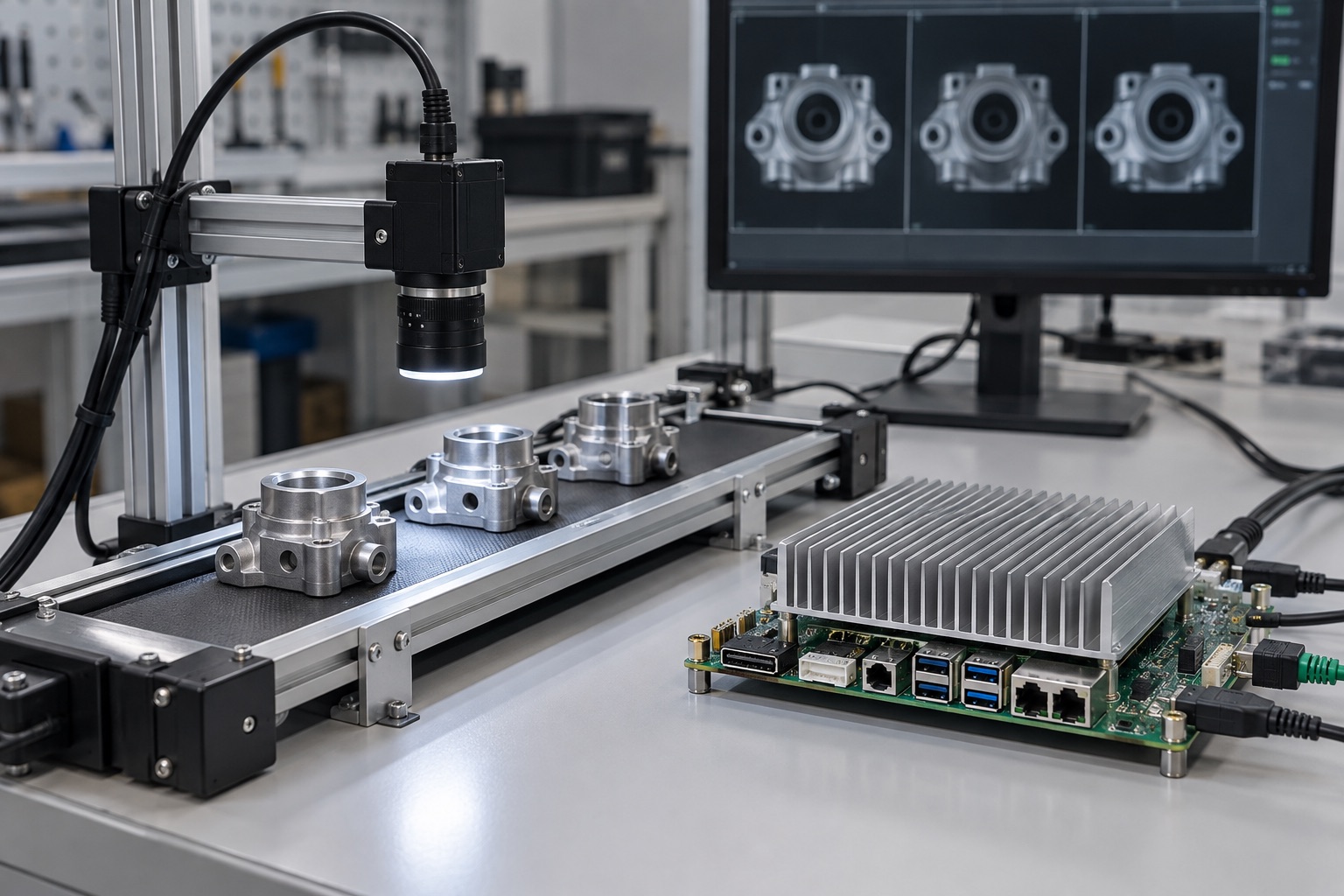
AI-generated engineering illustration; not a photograph of a verified i.MX95 inspection system.
Quick Answer#
NXP i.MX95 is a candidate when an industrial edge product needs application processing, local machine learning, graphics, connectivity, and separate real-time responsibilities. NXP lists up to six Cortex-A55 application cores, Cortex-M7 and Cortex-M33 cores, an eIQ Neutron NPU, and an EdgeLock Secure Enclave. Exact enabled features and limits depend on the selected device and implementation. See the official i.MX95 family page.
The platform deserves attention for integrated vision systems and sophisticated HMI, but it can add unnecessary complexity to a simple gateway. This guide explains how to evaluate its architecture and supplier deliverables. It does not claim measured inference performance, certified system safety, or a guaranteed support term for a particular module.
Identify The Workload That Justifies It#
A compelling use case combines several requirements: camera acquisition, local analysis, a responsive operator interface, and communication with surrounding equipment. Write down which tasks must run concurrently and which are optional. The processor should be selected for that combined workload rather than the most impressive isolated demonstration.
For a hypothetical visual inspection station, define image resolution, inspection rate, maximum decision delay, and the action taken after a failed inspection. Also define behavior when the camera disconnects or the model cannot produce a valid result. These conditions determine buffering and recovery requirements as much as normal throughput does.
| Product Requirement | Evaluation Focus | Evidence To Request |
|---|---|---|
| Vision inspection | Complete capture-to-decision pipeline | Accuracy, latency, and dropped-frame records |
| Rich industrial HMI | Graphics under concurrent processing | Input response and display stability |
| Connected edge appliance | Networking alongside inference | Traffic, isolation, and recovery tests |
| Mixed Linux and control software | Ownership across processing domains | Boot, IPC, and reset design |
| Long service life | Maintained hardware and software baseline | Written lifecycle and update responsibilities |
These are selection criteria, not automatic capabilities of any board carrying the chip. A SOM may expose only part of the available silicon interfaces.
Partition Linux And Real-Time Responsibilities#
Create a diagram showing which execution domain owns sensors, actuators, networking, and user interaction. Linux application cores can handle complex software, while other cores may serve separate responsibilities within a supported architecture. That division still requires deliberate boot, communication, and resource-management design.
Define the message protocol between domains. Include version identification, sequence numbers where useful, stale-data detection, and recovery after either side restarts. Shared memory does not remove the need for ownership rules or synchronization. A fast normal exchange says little about behavior when one participant stops responding.
Measure timing with realistic interference from display, storage, and network activity. If a function has a strict deadline, state the maximum allowed response and test the chosen scheduling and hardware arrangement. The presence of multiple core types alone does not prove determinism or isolation for the finished application.
Evaluate The NPU With The Actual Model#
Begin with model compatibility. Confirm supported operators, numeric representations, conversion tools, and runtime versions before relying on a theoretical accelerator figure. Preserve the original model, conversion settings, calibration data where relevant, and exported artifact. Otherwise a performance result may be impossible to reproduce after a tool update.
Measure capture, preprocessing, inference, and postprocessing separately and together. An accelerator can reduce one stage while copies or format conversion dominate the complete path. Report input-to-decision latency and accuracy with the final scheduling strategy. A benchmark that feeds prepared tensors does not establish camera-system performance.
Set acceptance criteria around the actual consequence of an error. A false reject may reduce production yield, while a missed defect may have a different cost. Test representative edge cases and retain the dataset version. Do not replace application accuracy with a generic model score from unrelated images.
Camera Integration Is A Supplier Deliverable#
Request support for the exact sensor, lens, interface arrangement, and operating mode. A camera connector does not establish driver support or image quality. Exposure control, tuning, synchronization, and timestamp behavior can determine whether the downstream model receives suitable inputs.
Test changing illumination, motion, reflective surfaces, and the expected working distance. Preserve sample frames before preprocessing so failures can be separated into optical, acquisition, and model problems. A dark or blurred input cannot reliably be repaired by selecting a more powerful processor.
Check shared interface constraints in the datasheet and carrier design. Multiple advertised peripherals may share pins or physical resources. Build a configuration table for the specific camera, display, and network combination, then have the supplier confirm it against the selected SOM and software release.
Graphics, Networking, And Memory Compete#
Concurrent traffic matters more than independent feature demonstrations. Run the operator interface while recording diagnostic images, exchanging network messages, and executing inference. Observe latency variation, memory pressure, and frame loss. Define an overload policy rather than allowing queues to grow indefinitely.
For streaming systems, decide whether the newest frame should replace an old one or whether every frame must be processed. Those policies have different memory and latency implications. A growing backlog can produce apparently good throughput while decisions refer to an increasingly outdated scene.
Memory capacity should include update operations, retained images, application services, and temporary processing buffers. Use a worst-case workload rather than idle consumption to select a module. Leave identified room for future software changes, but tie reservations to a product roadmap instead of choosing the largest memory configuration without evidence.
Security And Safety Need Separate Evidence#
NXP positions i.MX95 with security and functional-safety support. Those silicon and platform capabilities do not certify a finished inspection machine or medical device. Determine the applicable system requirements, obtain the appropriate documentation, and assign ownership for the complete implementation and validation.
For security, map the chain from provisioning through verified boot to application updates and service access. Decide who holds signing authority, how devices are identified, and what happens when credentials or firmware must be replaced. A secure enclave is one component of that design rather than a complete operational policy.
For safety-related designs, separate ordinary availability goals from formal safety functions. Identify the responsible subsystem and required evidence early. Avoid promoting a successful software demonstration into a safety claim because the processor family advertises relevant support.
SOM, Thermal, And Lifecycle Review#
A module can reduce DDR and power-design effort, but it creates a supplier dependency. Request carrier documentation, exact memory and storage specifications, source-access terms, supported software releases, and an escalation path for board-specific defects. Evaluate these deliverables before committing the mechanical design.
Measure sustained operation in the enclosure with the real cooling arrangement. Inspect processor and board temperatures, throttling, camera stability, and decision latency. Industrial operating conditions may also include dust, restricted airflow, and nearby heat sources. Open-bench results should not be presented as installation guarantees.
Confirm lifecycle coverage for the exact ordering code and module rather than inferring a fixed number of years from a family-level program description. Track component changes and software maintenance separately. A chip remaining orderable does not ensure that every carrier component or distribution package is maintained for the same duration.
Release Evidence#
| Review Item | Record To Retain |
|---|---|
| Pipeline | Sensor, input conditions, model, runtime, latency and accuracy |
| Platform | SOM, carrier revision, memory, storage, power and cooling |
| Software | Build manifest, BSP release, licenses, update mechanism |
| Failure handling | Camera loss, network interruption, reset and rollback outcomes |
| Supplier commitment | Availability statement, support scope, change-notification process |
Approve the platform when this evidence matches the product requirement. More capability is useful only when it reduces a demonstrated limitation or supports a planned function. Compare a smaller i.MX93 when the workload does not justify the integration effort.
FAQ#
Is i.MX95 a direct replacement for i.MX8M Plus? No. Treat it as a platform migration requiring hardware, BSP, accelerator, and peripheral review. Existing application code may be reusable, but that does not make the boards interchangeable.
Does an NPU specification establish inspection speed? No. Measure the model and complete input pipeline with the actual software and thermal configuration.
Does safety support certify my product? No. System requirements, implementation, verification, and applicable assessment remain separate responsibilities.
Sources And Related Guides#
Reviewed September 18, 2026. Architecture facts follow the NXP family page; electrical and ordering decisions require the industrial datasheet. Evaluation advice is editorial analysis, not a test report. See i.MX9 context and AI performance measurement.