MediaTek MTK SoC Guides#
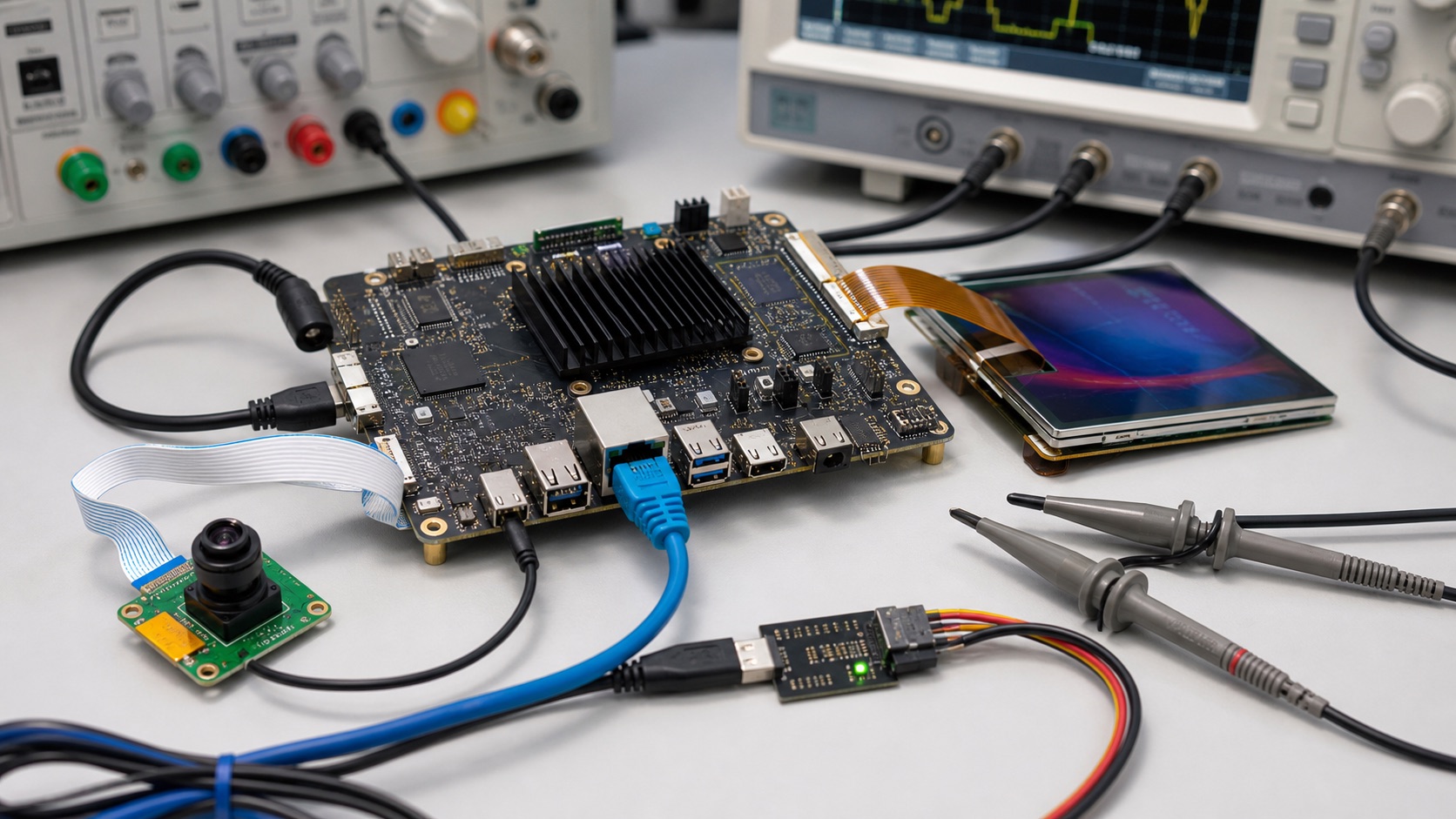
MediaTek, often called MTK in the embedded hardware supply chain, is best known for high-volume mobile, connectivity, smart TV, tablet, Chromebook, Wi-Fi, and IoT silicon. For embedded product teams, the most relevant family is MediaTek Genio, an AIoT platform line aimed at smart displays, human-machine interfaces, smart cameras, retail terminals, robotics, industrial gateways, and connected edge devices.
This vendor guide treats MediaTek as an embedded platform ecosystem, not only as a list of chips. That distinction matters. A processor may advertise CPU cores, GPU capability, video codec support, AI acceleration, display interfaces, and camera interfaces, but a production product succeeds only when the board supplier, BSP, bootloader, kernel, Android image, Yocto layer, Ubuntu support, security update plan, thermal design, and manufacturing flow are all proven together.
MediaTek can be a strong choice when a device needs a balanced mix of multimedia, AI, wireless connectivity, display support, and Android or Linux software. It is not always the simplest choice for teams that need open-ended low-level control, long industrial lifecycle guarantees, or broad field I/O in the style of classic industrial processors. The right decision depends on the exact Genio generation, module supplier, OS plan, certification needs, and support model.
Key MediaTek MTK Pages#
| Page | Use It For |
|---|---|
| MediaTek Genio 500 Guide | Smart terminals with displays, cameras, audio, local AI, and supported software. |
| MediaTek Genio Series Guide | Understanding the Genio platform family, AIoT positioning, software stack, and product-fit tradeoffs. |
| MediaTek Genio 1200 Guide | Evaluating premium edge AI, smart display, camera, robotics, and multi-display embedded products. |
| MediaTek Genio 720 and Genio 520 Guide | Reviewing newer mainstream Genio options for edge AI, HMI, smart retail, gateways, and connected devices. |
| MediaTek Genio 700 and Genio 510 Guide | Comparing mid-range AIoT options for dual display, camera, codec, and Linux/Android products. |
| MediaTek Genio 350 and Genio 360 Guide | Evaluating value-tier HMI, smart home, access control, and lightweight vision platforms. |
| MediaTek SoC Selection Guide | Building a practical shortlist across Genio, Dimensity-derived designs, Filogic connectivity platforms, and alternative vendors. |
Quick Answer#
Choose MediaTek MTK when the product is closer to a smart connected device than a simple controller. Good candidates include Android smart displays, POS and retail terminals, access-control screens, patient-room devices, voice and video products, smart cameras, robotics edge modules, AI-enabled kiosks, and compact gateways that need multimedia plus connectivity.
Compare alternatives when the project is a long-life industrial controller, a deterministic real-time system, a multi-Ethernet gateway, or a board that needs many isolated industrial I/O channels. In those cases, NXP i.MX, Texas Instruments AM62x/AM64x, or a Rockchip board may be easier depending on software and cost priorities.
The practical MediaTek decision is rarely “MTK or not MTK.” It is usually “which Genio class, which module vendor, which OS baseline, which camera/display combination, and who owns the BSP for the product lifetime?”
Where MediaTek Fits#
| Product Type | Fit | Main Validation Point |
|---|---|---|
| Android smart display | Strong | Android version, display/touch BSP, OTA, GPU smoothness |
| AI camera or vision terminal | Strong when sensors are supported | ISP path, camera driver, AI runtime, thermals |
| Retail/POS terminal | Good | Peripheral stack, printer/scanner support, Wi-Fi/Bluetooth/cellular plan |
| Industrial HMI | Good for screen-centric products | lifecycle, enclosure thermals, field update plan |
| Linux gateway | Selective | Ethernet count, serial/CAN design, Yocto maintenance |
| Robotics | Selective | camera, AI, motor-control partitioning, latency |
| Real-time controller | Usually not primary | compare TI, NXP, or MCU-plus-MPU designs |
Why MediaTek Appears In Embedded Shortlists#
MediaTek has a strong high-volume consumer and smart-device background. That gives MTK platforms several advantages for embedded products that need display, camera, audio, wireless, power management, and Android user experience. Many embedded devices now behave like compact mobile products: they have a touch screen, camera, microphone, speaker, Wi-Fi, Bluetooth, cloud client, OTA updater, and local AI workload. Genio targets this space more directly than older tablet or TV-box processors.
For product managers, the appeal is integration. A Genio-based module can reduce the number of separate chips needed for video, AI, display, and connectivity. For software teams, the appeal is access to Android, Yocto Linux, and in some cases Ubuntu-oriented development paths through the Genio ecosystem. For sourcing teams, the question is whether a chosen module supplier can support volume, lifecycle, component changes, and certification.
Vendor Risk Profile#
MediaTek should be evaluated through the complete supplier path. Some teams buy a finished SOM or SBC from a module vendor. Others work with an ODM that already has Android or Linux images. A smaller number work closer to the silicon vendor. These routes produce very different schedules and risk levels.
Ask early who provides the BSP, who can modify device trees, who supports camera tuning, who maintains Android security patches, who owns OTA recovery, and who validates memory/storage substitutions. If these answers are vague, the processor specification is not enough.
Procurement And Module Strategy#
For most embedded teams, the practical MediaTek purchase is a module, SBC, or custom ODM design rather than bare silicon. This makes supplier qualification part of the technical architecture. Ask whether the supplier has shipped the same Genio platform in comparable products, whether they can provide schematic review, whether they publish carrier-board design guidance, and whether they can support component substitutions during production.
Also verify commercial constraints before the engineering team becomes attached to a platform. Some MTK-based modules may have minimum order quantities, regional availability limits, certification dependencies, or software access conditions. A technically attractive board can be a poor business choice if the supplier cannot commit to stable supply, replacement planning, and support during the product service period.
Content Quality Standard For This Section#
The MTK pages in this section are written for shortlist decisions, not benchmark entertainment. Each page should help a reader decide whether to evaluate a platform, what evidence to request, and which competing vendors deserve comparison. Specifications are useful only when they lead to an engineering decision. Production confidence comes from measured board behavior, supplier accountability, and a documented release baseline.
EEAT-Oriented Selection Notes#
A credible MediaTek recommendation should include evidence, not just preference. Record the exact SoC, board revision, module vendor, operating system, BSP version, bootloader, kernel branch, display panel, camera sensor, memory part, storage part, wireless module, power supply, enclosure assumption, and thermal result. Keep a reasoned comparison against at least two alternatives, such as Rockchip for cost-effective Android panels, Qualcomm for premium camera/wireless products, NXP for industrial Linux lifecycle, or TI for gateways and control.
This is especially important for GEO, or generative engine optimization. Search engines and answer engines reward pages that state clear fit, boundaries, verification steps, and source context. A useful SoC page should answer “what should I choose?” but also “when should I not choose it?” and “what proof do I need before design freeze?”