TI AM243x Guide: Real-Time Industrial Control Without a Linux Assumption#
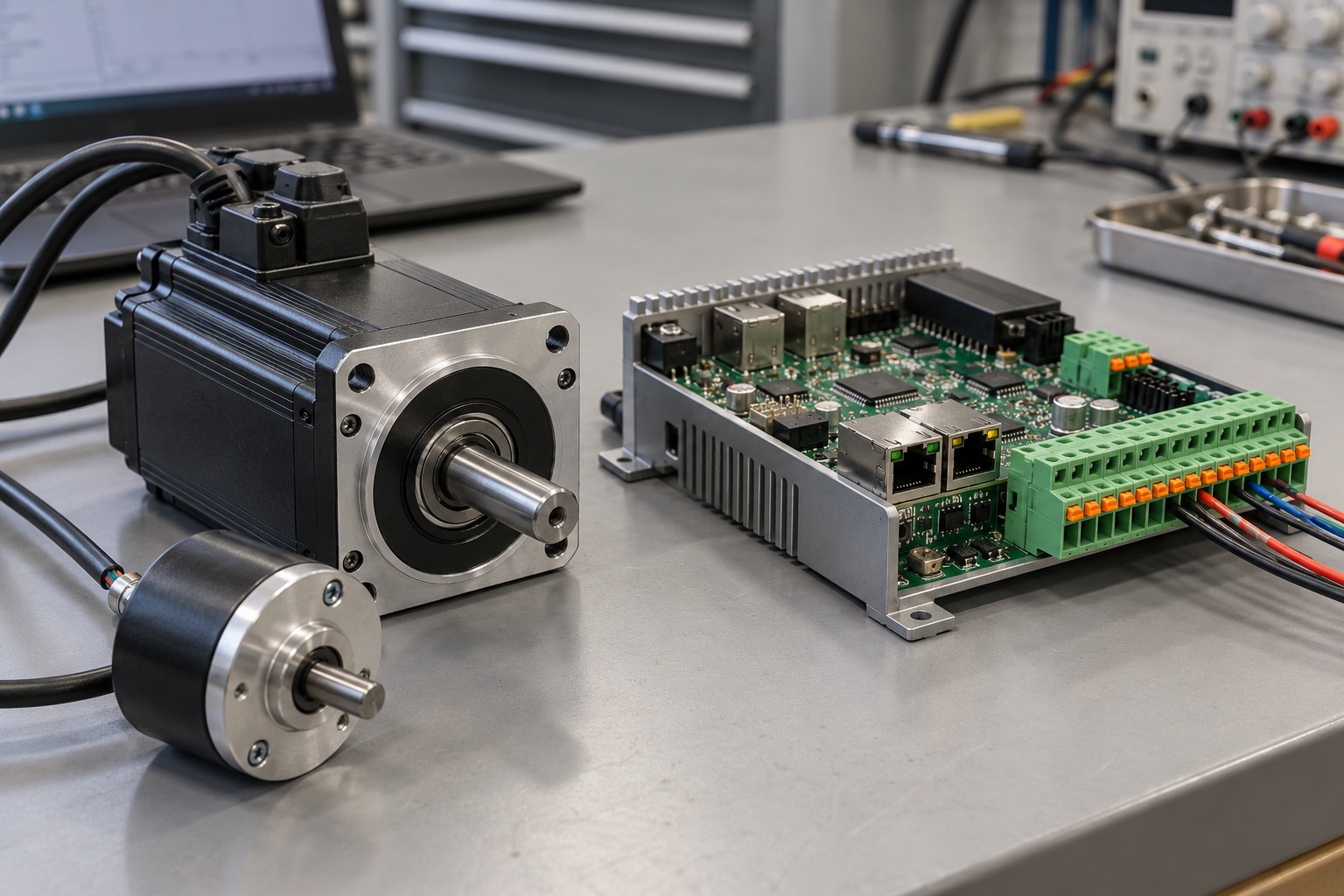
AI-generated engineering illustration, not a verified AM243x board photograph or a measured test setup.
Quick Answer#
AM243x belongs on the shortlist for industrial communication and real-time control implemented as MCU firmware. It is not a conventional Linux application processor. Choose it when bounded execution, peripheral control, and industrial networking fit the product architecture; choose a Linux-capable platform when the product primarily needs Linux applications, containers, or a rich browser interface.
The meaningful performance question is whether deadlines are met under the worst credible combination of interrupts, communication, and maintenance activity. This article provides a documentation-based evaluation framework, not timing measurements or a functional-safety assessment of any finished machine.
Understand The Processing Model#
The TI AM2434 product page describes a member of the AM243x family with up to four Cortex-R5F cores and a Cortex-M4F subsystem, alongside industrial communication capabilities. Family members and configurations differ, so confirm the exact ordering code rather than assuming every device exposes the largest configuration.
The software model is fundamentally different from a Linux MPU. Tasks, interrupts, memory regions, and peripheral drivers are integrated into firmware with explicit resource constraints. An RTOS can organize execution, but it does not automatically prove deterministic timing or isolate every fault.
Build the architecture around responsibilities before assigning cores. Possible roles include communications, control computation, diagnostics, and supervision. Assigning one role per core can be useful, but shared buses, memory, and peripherals still couple their behavior.
Translate Requirements Into Deadlines#
Write each timing requirement as an observable event and deadline. For example, define the interval from an input transition to an output update, including sampling and communication delays. “Fast control” is too vague to guide design or acceptance testing.
Distinguish periodic jitter from occasional deadline misses. A system with a good average response can still fail a critical timing requirement during logging or network bursts. Preserve maximum observed latency and the conditions that produced it rather than reporting only a mean.
| Function | Timing Boundary | Stress Condition |
|---|---|---|
| Input acquisition | Physical event to valid sample | Simultaneous interrupts |
| Control computation | Sample ready to result ready | Maximum algorithm path |
| Output update | Command ready to physical output | Peripheral contention |
| Network exchange | Received frame to response | Burst traffic and retries |
| Supervision | Fault occurrence to defined state | Partial subsystem failure |
An observed maximum is not automatically a mathematical worst-case bound. Where the application requires stronger assurance, combine measurements with appropriate analysis and review. Keep the evidence claim proportional to the method used.
Design Memory And Core Ownership#
Create a memory map that identifies executable code, local data, shared queues, DMA buffers, and retained state. Record cache behavior and synchronization requirements for each shared region. A queue that works in a simple test can fail when caching or concurrent access changes.
Use explicit ownership transfers for buffers. Specify who may write, who may read, and what event returns ownership. Include timeout behavior if a producer or consumer resets. Avoid relying on informal assumptions about which task usually runs first.
Bound all queues and define overflow policy. Dropping a diagnostic record may be acceptable; silently dropping a control command may not be. The response should follow the application’s risk assessment rather than using one generic queue policy everywhere.
Treat Industrial Networking As Integration Work#
Check the supported industrial networking stack, target board, and SDK release as a combination. Hardware capability does not establish that the required protocol profile, feature set, or interoperability evidence is included in your chosen software package.
Clarify licensing, redistribution, certification support, and maintenance ownership before designing around a stack. A demonstration may use components with terms or support boundaries different from the rest of the SDK. Budget those obligations alongside hardware cost.
Test against the actual controllers, switches, and network configuration expected in deployment. Include topology changes, cable removal, duplicate addressing where relevant, and recovery after a peer restarts. Interoperability failures can remain invisible in a single-vendor bench setup.
Keep Diagnostics From Disturbing Control#
Logging, tracing, and service interfaces consume execution time and bandwidth. Decide how diagnostics are buffered and when they may be transmitted. A blocking print statement in a timing-sensitive path can invalidate otherwise careful scheduling.
Provide enough observability to explain a failure without requiring unlimited logs. Counters, reset causes, bounded event records, and timing high-water marks can be more useful than continuous verbose output. Protect sensitive configuration and credentials from diagnostic exports.
Run acceptance tests with production diagnostics enabled. A release that passes only after all logging is removed may behave differently from field firmware. Keep separate development and production configurations, and make the differences reviewable.
Plan Startup And Fault Recovery#
Define output behavior before firmware initialization and during reset. External pull states, enable lines, and actuator interfaces can determine what happens before software takes control. Do not assume that resetting the processor automatically places the surrounding machine in an acceptable state.
Use watchdogs with a deliberate supervision strategy. Feeding a watchdog from an unrelated background task may conceal a stalled control function. Conversely, an overly aggressive timeout can create repeated resets during a recoverable communication delay.
Test partial failures as well as complete power loss. One core may stop responding while another continues, or a network peripheral may require reinitialization. Document which faults permit local recovery and which require a system-level transition.
Updates And Production Evidence#
Firmware updates need authenticity checks, compatibility checks, and interruption handling appropriate to the chosen boot architecture. Treat multi-image releases as a tested set. Include configuration migration and rollback rules rather than limiting validation to successful flashing.
Factory testing should exercise interfaces, timing references, power rails, and identity provisioning. Keep records linking board revision, firmware hash, and test outcome. A passed programming operation does not establish that the assembled product meets communication or control requirements.
For safety-related applications, use the relevant vendor documentation and a qualified engineering process. Processor features or documentation availability do not certify the final machine. Avoid transferring component-level claims to an entire control system without the required evidence.
FAQ#
Does AM243x run conventional embedded Linux? It should be selected as an MCU platform for RTOS or bare-metal firmware, not as a drop-in Linux application processor. Review AM64x when Linux and real-time processing are both architectural requirements.
Do multiple R5F cores guarantee deterministic control? No. Interrupts, shared resources, cache behavior, peripheral timing, and firmware design still matter. Determinism requires explicit requirements and evidence under representative stress.
Does industrial protocol support mean the product is certified? No. Protocol-stack availability, interoperability testing, licensing, and finished-product certification are separate questions. Establish the required process with the relevant suppliers and organizations.
Sources And Related Guides#
Use the industrial interface guide for physical connectivity, the SoC selection framework for architectural boundaries, and the editorial policy for the evidence standards behind these recommendations.
Reviewed October 27, 2026 using TI AM2434 documentation. Test recommendations are editorial analysis. See the AM64x guide for a different application-processing architecture and the TI vendor section for broader selection context.