ESP32-H2 Guide for Thread and Zigbee Devices#
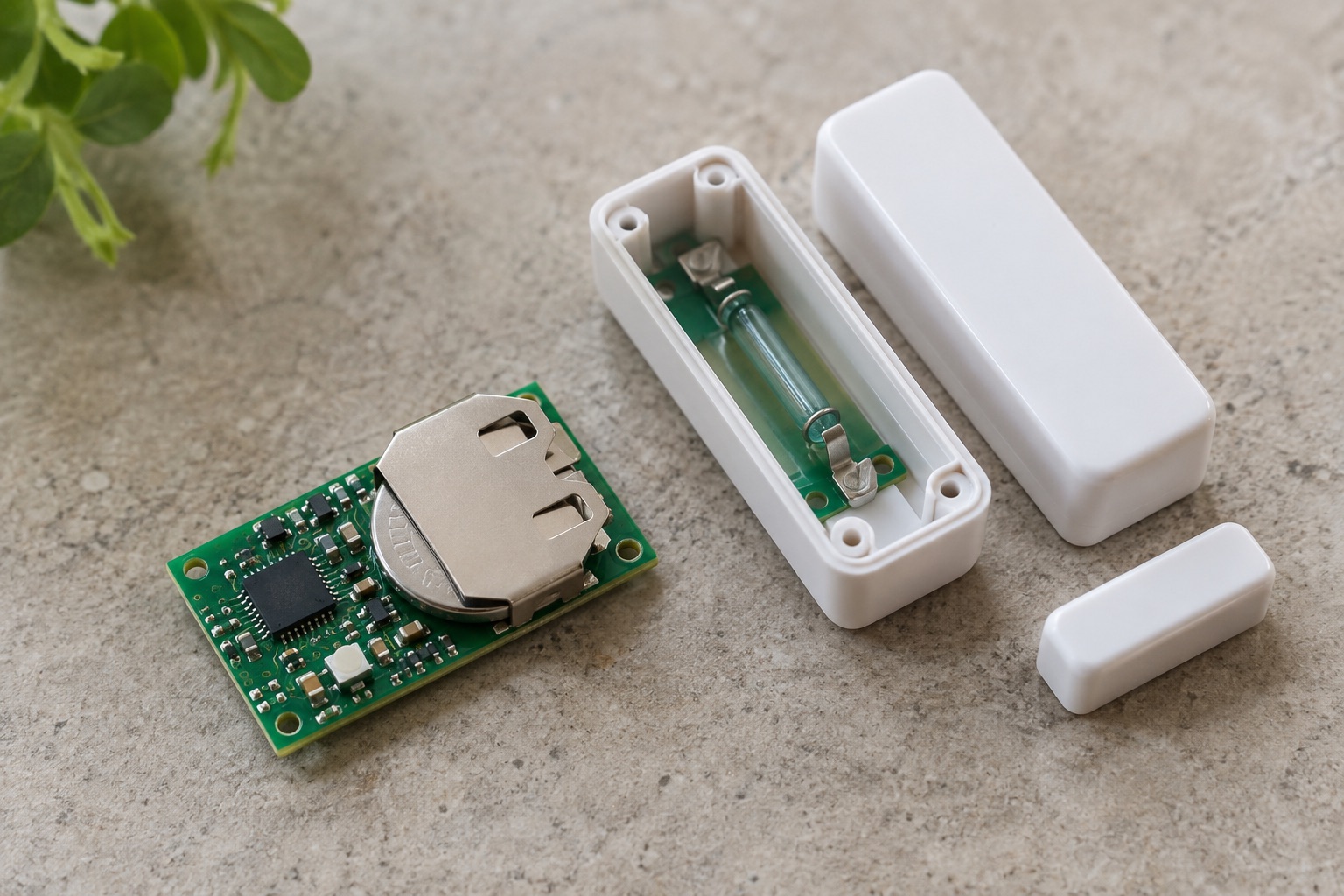
AI-generated application illustration; component placement and battery choice are not a reference design.
Quick Answer#
ESP32-H2 is a microcontroller SoC with Bluetooth LE and IEEE 802.15.4, intended for applications such as Thread or Zigbee endpoints. It does not integrate Wi-Fi. Evaluate it when the product’s network architecture supports a mesh endpoint and when local processing, memory, and power requirements fit the selected implementation. The official H2 overview is the starting point for hardware capabilities.
A battery sensor is a plausible application, but long battery life is not an automatic consequence of selecting H2. Network role, polling, retries, sensors, and regulator behavior determine energy use. This article offers a qualification method and highlights a relevant security advisory; it does not report hands-on endurance or interoperability results.
Choose The Network Role First#
An endpoint, a mesh router, and a border router have different responsibilities. An endpoint may prioritize sleep and occasional reporting. A routing device helps carry other traffic and needs an appropriate availability policy. A border router connects the Thread network to adjacent IP infrastructure and requires a complete system design.
H2’s radio can be part of a larger host-based architecture, but H2 alone does not acquire Wi-Fi because a border-router example exists. Document the host, interface, firmware boundary, and update ownership for a split design. A reset on either side should produce a defined recovery sequence.
| Intended Role | Product Requirement | Early Validation |
|---|---|---|
| Door or window sensor | Event delivery with long idle periods | Missed events, wake energy, retries |
| Environmental sensor | Periodic reports and battery monitoring | Sampling accuracy and report schedule |
| Powered mesh device | Stable participation in the network | Rejoin and infrastructure failure behavior |
| Radio companion | Reliable communications with a host | Host resets and protocol compatibility |
| Direct Wi-Fi device | Native Wi-Fi connection | Choose a different architecture |
Treat these as possible design directions, not a list of prequalified products. The selected protocol stack and release determine which device roles are supported and how they should be configured.
Thread, Zigbee, And Matter Are Different Choices#
Thread and Zigbee both use IEEE 802.15.4 but are not the same network stack. A Zigbee device does not join a Thread network simply because its radio uses the same underlying standard. Pick the ecosystem from customer requirements and integration partners before building application behavior.
Matter over Thread adds application behavior and commissioning requirements above the Thread network. It does not remove the need for a supported controller and infrastructure. Map the intended device functions to the chosen application model, then verify how they are represented in the ecosystems the product will support.
For example, a contact sensor may need more than an open or closed value. Battery state, fault reporting, identification, and update behavior can affect the customer experience. Define those functions explicitly rather than exposing only the minimum data that makes a development example appear in an app.
Design Sleep Around Event Delivery#
Start with the acceptable delay between an event and its reception. A periodic temperature report can tolerate different behavior from a user-operated switch. Determine which signals can wake the product, how events are queued, and what happens if several changes occur before a successful transmission.
Avoid assuming that the deepest sleep state is always the most efficient system choice. Rejoining or rebuilding state may cost energy and delay. Compare candidate operating modes using the complete event cycle, including network maintenance. The right configuration depends on the role and the responsiveness expected by the user.
Measure false wakeups as well as legitimate ones. Mechanical contacts, noisy inputs, or poorly chosen thresholds can wake a sensor unnecessarily. Debounce and filtering policies should preserve meaningful events while limiting avoidable work. Validate them with physical inputs and realistic temperature variation, not only a simulated software trigger.
Battery Selection Needs Pulse Measurements#
Build a power trace covering startup, commissioning, reporting, retry, and update activity. Measure at the battery input, and include the sensor, regulator, status indicator, and leakage paths. A bench supply with long leads or different source impedance may hide behavior that appears with a small battery.
A coin-cell illustration is not a recommendation for every H2 design. Battery chemistry, pulse capability, temperature, useful capacity, and mechanical requirements must be evaluated together. Test near the intended replacement threshold. A device should warn about declining power while it can still communicate reliably enough to deliver the warning.
Define an energy budget for infrastructure failure. If the parent or network disappears, repeated attempts to reconnect can overwhelm normal consumption. Use a recovery policy matched to the importance of the data and keep a measurable limit on retry activity. Record how long an outage can be tolerated without losing required information.
Commissioning And Ownership Transfer#
Use a supported commissioning flow for the selected stack. A small device still needs discoverable setup behavior, cancellation, and a way to recover from an incomplete attempt. Where Bluetooth LE is part of setup, verify the transition to normal operation and ensure commissioning does not remain unintentionally open.
Test device movement between networks and changes to ownership. Distinguish a network reset from a complete customer-data reset, and protect the manufacturing identity from accidental erasure. Instructions should match the exact button and indicator behavior of production hardware, including operation at low battery voltage.
For Matter development, use the Espressif Matter guide as the implementation entry point. Keep the selected release and device configuration with test evidence. Cross-ecosystem operation needs its own evaluation; successful commissioning with one controller cannot establish universal compatibility.
Review Chip Revision And Security Advisories#
Espressif advisory AR2026-006, revision V1.1 dated July 28, 2026, identifies an ECDSA secure-boot issue affecting H2 through chip revision v1.2. Exploitation requires the ability to manipulate the firmware image and signature in flash. The advisory recommends RSA secure boot for new production batches on affected products where supported; consult it for exact mitigations and migration constraints.
The practical lesson is to qualify silicon revision and boot configuration together. Do not approve a device based only on a generic secure-boot feature row. Archive the relevant advisory review with the release record and recheck it before procurement or production changes. This is a target-specific requirement, not a reason to assume every ESP32 family has the same issue.
Updates Must Fit A Low-Power Product#
Firmware delivery over a constrained network can consume time and energy. Establish the update source, device wake policy, image capacity, and interruption behavior before shipping. Test the selected protocol’s delivery mechanism; do not assume a Wi-Fi HTTPS example applies unchanged to an H2 endpoint.
Retain a recoverable application state after incomplete updates. First-boot health checks should reflect the product’s local operation and network role without requiring an unavailable cloud service to declare success. For the broader design principles, see ESP-IDF security and OTA, then use target-specific documentation for implementation.
Pilot Qualification Record#
| Area | Evidence To Capture |
|---|---|
| Network | Stack version, role, controller, topology, recovery cases |
| Energy | Battery type, voltage, temperature, event and retry traces |
| Application | Event loss, latency, retained data, reset behavior |
| Security | Chip revision, boot scheme, advisory review, identity policy |
| Updates | Starting version, interrupted stage, resulting firmware state |
Run the pilot with realistic distances and obstructions. Preserve failures as well as passing results so a firmware revision can be evaluated against the same conditions. An acceptance report is more useful when another engineer can reproduce the observed behavior without relying on the original developer’s memory.
FAQ#
Can ESP32-H2 connect directly to a Wi-Fi router? No. It has no integrated Wi-Fi radio. Use a suitable companion or compare a family such as C6 if native Wi-Fi is required.
Is H2 automatically the lowest-power ESP32 option? There is no universal answer for finished products. Compare complete duty cycles, radio roles, and external components under the same application requirements.
Can a Zigbee firmware image be treated as Matter firmware? No. The protocols and application integration differ. A bridge is a separate architecture with explicit translation and state-management responsibilities.
Sources And Editorial Basis#
Reviewed September 18, 2026 using the manufacturer pages, SDK entry point, and security advisory linked above. Recommendations are proposed engineering checks, not certification evidence. See series selection and the Espressif overview for the wider shortlist.