Qualcomm QCS610 Guide: Smart Camera Selection Beyond the Demo#
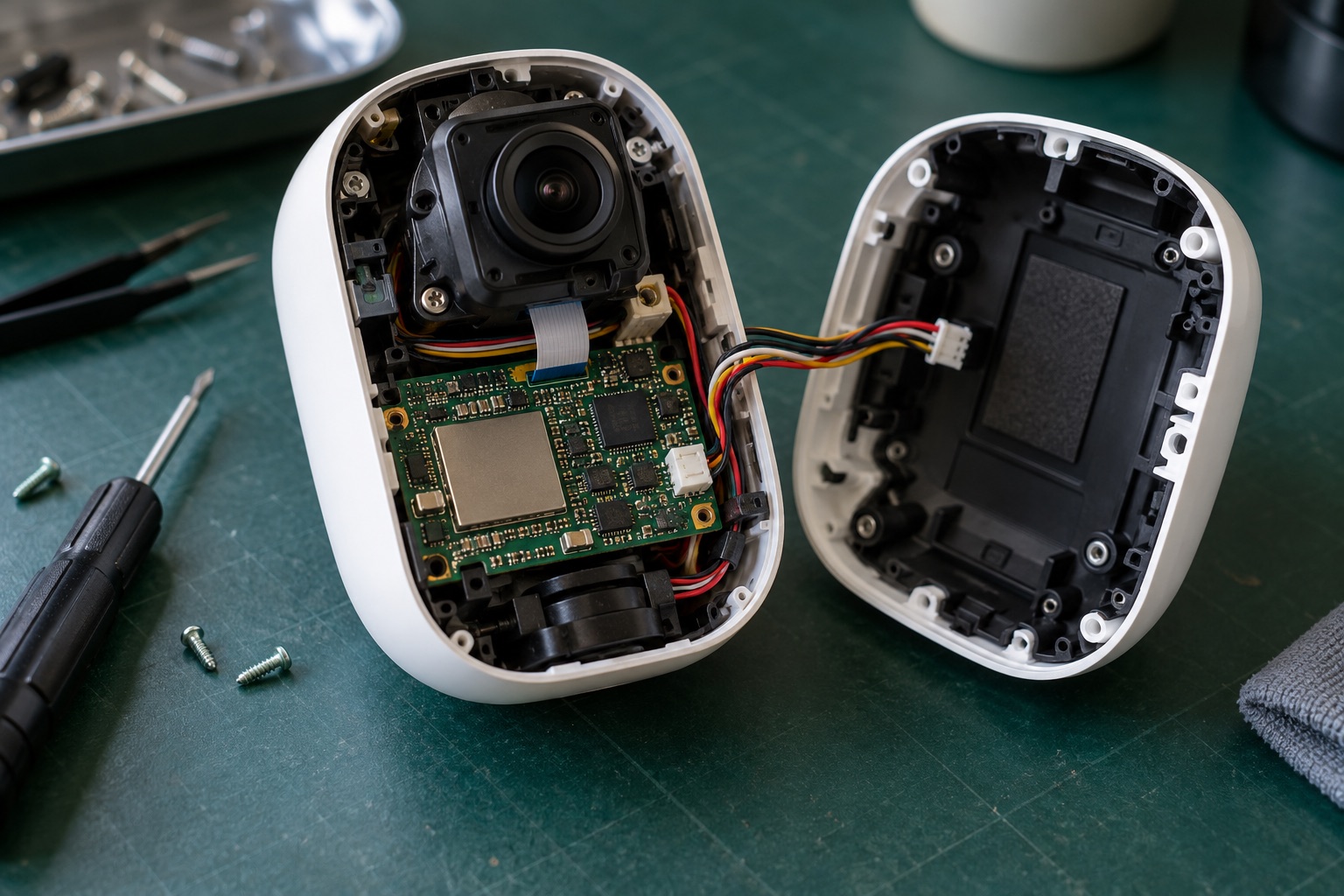
AI-generated engineering illustration, not a verified QCS610 board photograph or a measured test setup.
Quick Answer#
QCS610 is a candidate for connected camera products that need integrated imaging, local analytics, and application software. Evaluate the exact module and supported BSP before selecting it for a new design. A convincing camera demonstration is not enough: the production decision depends on sensor tuning, concurrent workloads, software access, and a credible maintenance commitment.
For an existing QCS610 design, the review may focus on sustaining software and replacement supply rather than maximizing benchmark scores. This guide provides a documentation-based assessment and proposed tests. It does not claim hands-on measurements, guaranteed lifecycle dates, or certification for any finished device.
Establish The Platform And Supplier Boundary#
Qualcomm’s QCS610 product brief describes an octa-core Kryo CPU, Adreno graphics, and Hexagon processing within a camera-oriented platform. These blocks establish the general architecture, but they do not specify the performance of a particular application pipeline.
Identify the exact module, memory configuration, camera interface routing, and available development software. Ask which components come from Qualcomm, which are maintained by the module vendor, and which require separate commercial access. Support boundaries are especially important when a failure crosses driver, firmware, and application layers.
Request a written list of deliverables before purchase. Include build instructions, board support, recovery images, supported sensors, tuning data, and known limitations. An evaluation kit can be useful while still lacking the material required to maintain a custom production board.
Select The Camera Around The Scene#
Start with scene requirements: distance, field of view, motion, illumination, and acceptable failure modes. Pixel count alone cannot describe whether an image is useful. A poorly chosen lens or exposure strategy can undermine both human viewing and machine inference.
Verify that the proposed sensor has a supported driver and suitable image-quality tuning. The tuning should match the optical assembly closely enough to be relevant. A different lens, infrared filter, or illumination source may require additional work even when the sensor model is unchanged.
Capture difficult transitions during evaluation. Backlighting, shadows, reflective surfaces, and changes between indoor and outdoor lighting can expose problems hidden by a well-lit demonstration. Keep the capture configuration with each test set so results remain interpretable after software changes.
Separate Imaging, Inference, And Encoding#
These stages share a product but have different bottlenecks. Image processing prepares frames, inference produces model outputs, and encoding compresses video. Successful operation of each component alone does not establish that the combined application has enough bandwidth or memory.
Build the production pipeline early, including overlays, network transport, and recording if required. Measure useful result latency alongside encoded stream quality and dropped frames. A camera that maintains its video stream while analytics silently lag may fail the actual product requirement.
| Workload | Measure | Watch For |
|---|---|---|
| Camera preview | Frame interval and image quality | Exposure or buffer instability |
| Local analytics | Event-to-result latency | CPU fallback and stale frames |
| Recording | Sustained write behavior | Storage stalls and growing queues |
| Remote streaming | Recovery and transport delay | Congestion and reconnect storms |
| Combined operation | Thermal and memory high-water marks | Resource contention |
Define which workload has priority when resources become constrained. For example, a monitoring product may prioritize current alerts over archival frame rate. Make the degradation policy explicit rather than allowing accidental scheduler behavior to decide.
Verify Model Deployment Before Hardware Commitment#
Use a model representative of the intended application, not only a vendor sample. Confirm the supported runtime and conversion path for the exact BSP. Record framework version, operators, quantization settings, and model artifact hashes.
Measure accuracy after conversion and after production preprocessing. Changes in resize strategy, normalization, channel order, or crop geometry can alter results. Keep preprocessing code under the same release controls as the model because it is part of the deployed algorithm.
Do not equate a successful conversion with efficient execution. Inspect where operations run and whether unsupported portions fall back to the CPU. The result may be functionally correct while missing latency or thermal requirements under concurrent camera and network activity.
Review Software Maintenance As A Contract#
Ask for the supported operating-system versions, security patch process, and expected release cadence. Distinguish a chipset support statement from the module vendor’s commitments and your own application maintenance. These are related but separate obligations.
For new projects, verify current availability directly instead of relying on an old product brief or distributor listing. Obtain change-notification arrangements and a plan for component substitutions. A nominally available processor does not guarantee that a preferred module configuration will remain unchanged.
Archive the software manifest and build inputs for each release. A binary image without a reproducible origin makes later vulnerability assessment difficult. Record proprietary dependency versions as well as open-source packages, even when their internal implementation is not available to you.
Test Thermal Behavior In The Intended Enclosure#
Camera products often have restricted airflow and heat from sensors, radios, and illumination. Run the complete workload inside a representative enclosure until temperatures stabilize. Capture clocks, latency, dropped frames, and power alongside ambient conditions.
Test the hottest realistic operating mode, not just the most common one. Simultaneous analytics, recording, upload, and an illuminated scene may create a different thermal profile from idle monitoring. Include mounting orientation and installation surfaces when they affect heat transfer.
Avoid reporting a single short-run throughput figure as sustained product capability. State test duration, workload configuration, and whether throttling occurred. Clear conditions make performance evidence useful to engineering and procurement teams alike.
Build Recovery And Privacy Into Operations#
Plan how the device behaves when the network disappears, storage fills, or a stream becomes corrupt. Bound local queues and define retention rules. Recovery should not require an operator to connect a development cable to every installed camera.
Use authenticated updates with hardware and software compatibility checks. Test interruption during installation and verify rollback with the actual model and configuration data. An image that boots successfully may still leave analytics or camera tuning incompatible.
Minimize unnecessary image retention and diagnostic exposure. Decide which frames are needed for service, how access is controlled, and how data is removed during decommissioning. These decisions should follow the deployment’s privacy requirements rather than being deferred until after installation.
FAQ#
Is QCS610 suitable for a new smart camera? It may be, but verify the current module, BSP, sensor support, and maintenance commitment. Existing integration advantages should be weighed against the remaining product lifecycle.
Does the platform brief prove simultaneous analytics and recording speed? No. Concurrent performance depends on the sensor mode, model, software path, memory traffic, encoding settings, and enclosure. Measure the combined application.
What supplier evidence matters most? A supported sensor and tuning package, reproducible software release, documented security maintenance, recovery procedure, and written availability terms are more useful than a polished demonstration alone.
Sources And Related Guides#
Related implementation checklists cover camera interfaces, real AI performance, and BSP quality.
Reviewed October 27, 2026 using the official Qualcomm product brief linked above. Evaluation methods are editorial recommendations. Compare the QCS6490 guide for a different platform class and the Qualcomm vendor section for other options.