ESP32-C3 Guide for Wi-Fi Sensors and Controllers#
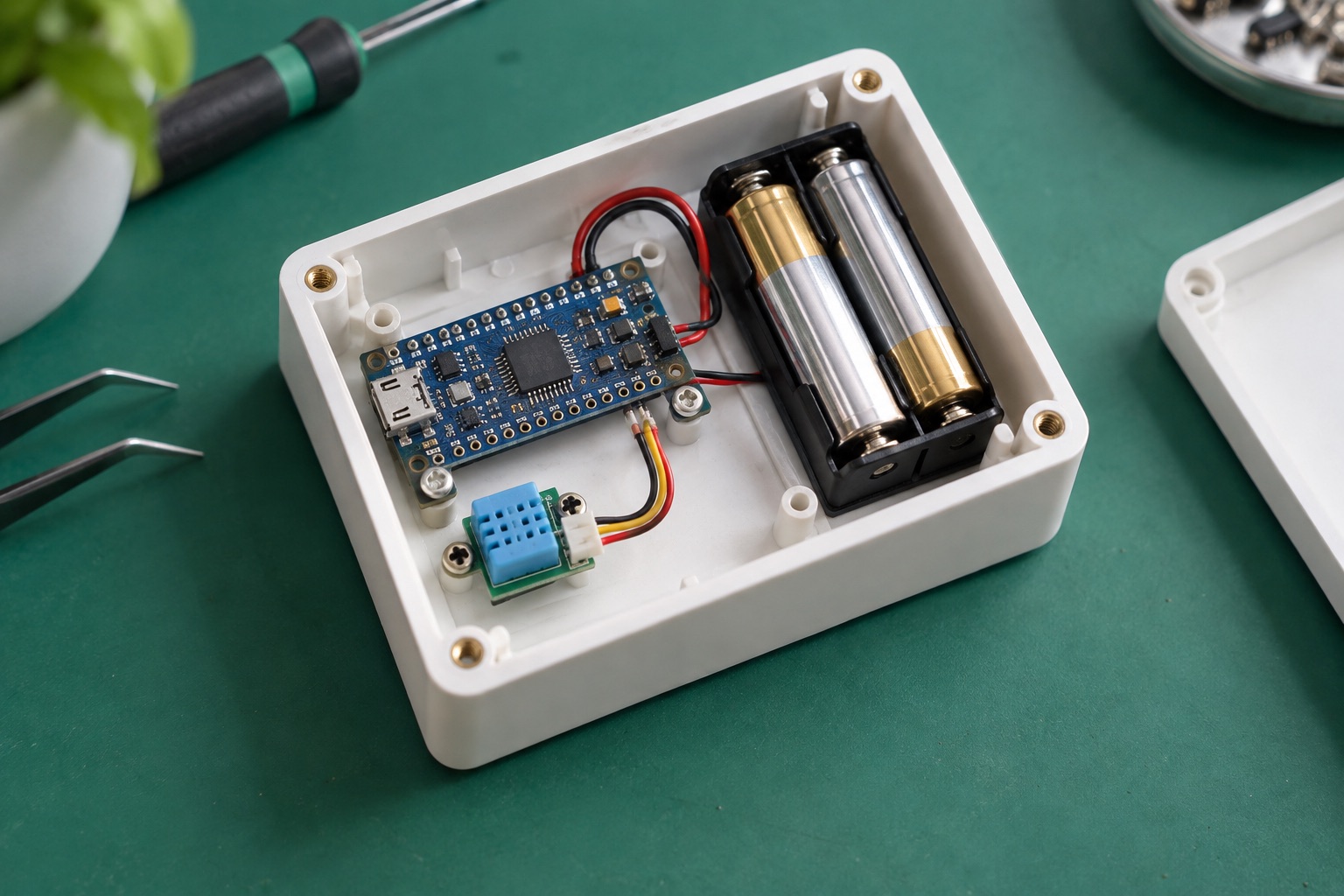
AI-generated illustration; it does not document a measured battery-life experiment.
Quick Answer#
ESP32-C3 is a sensible candidate for a compact connected product with limited application complexity. Espressif specifies a single-core RISC-V processor up to 160 MHz, 400 KB internal RAM, 2.4 GHz Wi-Fi, and Bluetooth LE. Consider it for sensor reporting, appliance control, and wireless configuration when the complete firmware fits with margin. See the official C3 product page.
The strongest reason to choose C3 is a well-bounded application, not simply a low advertised board price. Development time, antenna integration, provisioning, update storage, and field support determine the delivered product cost. This article provides an evaluation method, without claiming a measured price advantage or battery-life result.
Define The Small Connected Application#
A basic sensor product might wake, read one or more inputs, establish a secure connection, publish a message, and sleep. A controller may remain powered, respond to local buttons, and exchange commands over the network. Those patterns have different latency and energy requirements even if they use the same chip.
Specify local behavior when connectivity disappears. A ventilation controller should have a defined response to missing remote commands; a data logger should know whether to retain samples. The right policy depends on the product, but it must be explicit. Network availability should not accidentally determine whether basic controls remain responsive.
Keep the feature list concrete. Record sensor count, sample rate, message size, simultaneous connections, log depth, and update frequency. These quantities support memory and timing estimates. Labels such as industrial IoT or smart home are too broad to establish whether C3 has sufficient resources.
Understand The Resource Tradeoff#
| Design Area | C3 Evaluation Focus | When To Reconsider |
|---|---|---|
| Application tasks | Bounded processing and short deadlines | Sustained processing dominates the CPU |
| Connectivity | Complete secure-session memory peak | Required connections exceed practical memory |
| User interface | Simple controls and limited graphics | Large framebuffers become central |
| Radio choice | Wi-Fi and Bluetooth LE | Native IEEE 802.15.4 or Classic is required |
| Product growth | Named features with reserved resources | Roadmap depends on speculative headroom |
Do not translate the internal RAM specification into available application heap. Firmware, stacks, drivers, and system allocations already consume part of the resource. Measure the actual build after enabling production logging, security, and networking. Removing these components for a benchmark can hide the peak that matters at shipment.
Budget Energy Per Event#
Battery life depends on the whole operating cycle. Separate wake, sensing, association, secure connection, transmission, and sleep. Measure current at the product supply input so regulator losses and peripheral leakage are included. Chip-only estimates are useful for comparison but cannot establish finished-device endurance.
For a transparent hypothetical calculation, suppose active operation draws 80 mA for two seconds every five minutes, and the remaining 298 seconds draw 0.02 mA. The weighted average is about 0.553 mA. These invented inputs illustrate arithmetic only; they are not C3 measurements or an expected product result.
Real battery sizing must then allow for usable capacity, temperature, aging, self-discharge, peak load, and failed transmissions. Test with the selected chemistry and end-of-life voltage. A supply that appears adequate when fresh may sag during a radio burst after months of service. The resulting resets can increase retries and worsen energy use.
Design Reconnection Before Optimizing Sleep#
Weak coverage and unavailable infrastructure can dominate consumption. Set bounded retries and a backoff policy that matches the product’s reporting needs. Decide how the device signals a prolonged outage and how much data it retains. Avoid an uncontrolled reconnect loop that keeps the radio active until the battery is exhausted.
Test changed credentials, router replacement, loss of time synchronization, and unreachable application servers. These failures occur at different layers and need different recovery actions. Repeatedly erasing configuration may make an outage worse by requiring customer intervention. Preserve enough diagnostic state to distinguish a network problem from corrupted settings.
For a sensor that sleeps for long intervals, measure connection establishment each time. Keeping a session alive may reduce repeated setup but increase connected idle energy. Neither strategy is automatically superior. Compare the complete duty cycle under representative signal conditions and the actual backend’s timeout behavior.
Make Provisioning A Product Feature#
Provisioning includes more than receiving a Wi-Fi password. Users need a way to identify the device, transfer credentials, recognize success, recover from failure, and transfer ownership. A nearby Bluetooth LE flow may help with configuration, but the application must still define authorization and protect sensitive information.
Test the procedure on supported phones and network types. Include a mistyped password, interrupted setup, repeated setup requests, and a device already assigned to another account. Document what factory reset removes. Clearing customer configuration should not inadvertently destroy immutable manufacturing identity or make the device impossible to service.
Give local status indicators meaningful states. A device with one LED still needs to distinguish setup, normal operation, and an actionable failure. Avoid making users infer state from arbitrary timing that changes between firmware versions. The hardware and firmware teams should agree on this interaction before enclosure tooling.
Module And Board Review#
Use the exact module datasheet to allocate pins and antenna clearance. Check power-up behavior, boot pins, peripheral voltage compatibility, and programming access. Available pins depend on packaging and module implementation, so the headline chip GPIO count is not a wiring plan.
Select a regulator for transient performance and low-load efficiency, then validate both. A supply optimized only for low quiescent current may perform poorly during bursts. Locate decoupling according to the reference design, and examine the supply with an appropriate instrument while reproducing worst-case activity.
Evaluate antenna performance inside the final enclosure with batteries installed. A metal mounting bracket, cable bundle, or nearby ground area may change the link enough to affect retries and battery life. Preserve the tested antenna arrangement in the production specification so a mechanical revision triggers an appropriate review.
Secure Updates On A Small Device#
Reserve firmware-update capacity at the beginning. Two application slots and associated data consume storage that cannot simultaneously be promised to logging or assets. Check the size of a production build, including enabled security and diagnostics, against the intended partition layout.
Use the target-specific ESP-IDF security guide to review boot verification, flash protection, and provisioning. These controls serve different purposes. The engineering task is to define who may install firmware, how credentials are protected, and which recovery operations remain available after production configuration.
Test interrupted downloads and unsuccessful first boots. A connected sensor may be asleep or offline when an update campaign begins, so keep a supported upgrade path from older releases. Track deployment by hardware revision and firmware version, not merely by whether the server transmitted a file.
Compare C3 With Adjacent Options#
Move toward S3 when graphics, audio, or processing requirements justify a different resource balance. Investigate C6 when IEEE 802.15.4 or its Wi-Fi feature set is relevant. Consider H2 when the product is a mesh endpoint without native Wi-Fi requirements.
Keep C3 on the shortlist when it passes the complete workload and has a maintainable software baseline. Additional silicon capabilities are not useful unless the product benefits from them. Conversely, repeatedly removing diagnostics to fit a device is a signal that the resource budget needs reconsideration.
FAQ#
Is ESP32-C3 suitable for battery sensors? Potentially. Duty cycle, reconnect behavior, regulator losses, sensors, and battery characteristics determine the result. Measure the assembled product before publishing endurance claims.
Does C3 provide native Thread radio support? It does not include IEEE 802.15.4. A design requiring that radio needs another suitable family or an additional component.
Can C3 handle secure cloud communication? It can support connected firmware using the appropriate SDK components, but validate memory peaks, certificate handling, reconnect behavior, and update operation together.
Sources And Editorial Basis#
Reviewed September 18, 2026. Specifications follow the linked manufacturer overview and target-specific documentation. Energy inputs are explicitly hypothetical; no bench results are asserted. Continue with series selection, secure OTA deployment, and our editorial policy.