Espressif ESP32 SoC Guides#
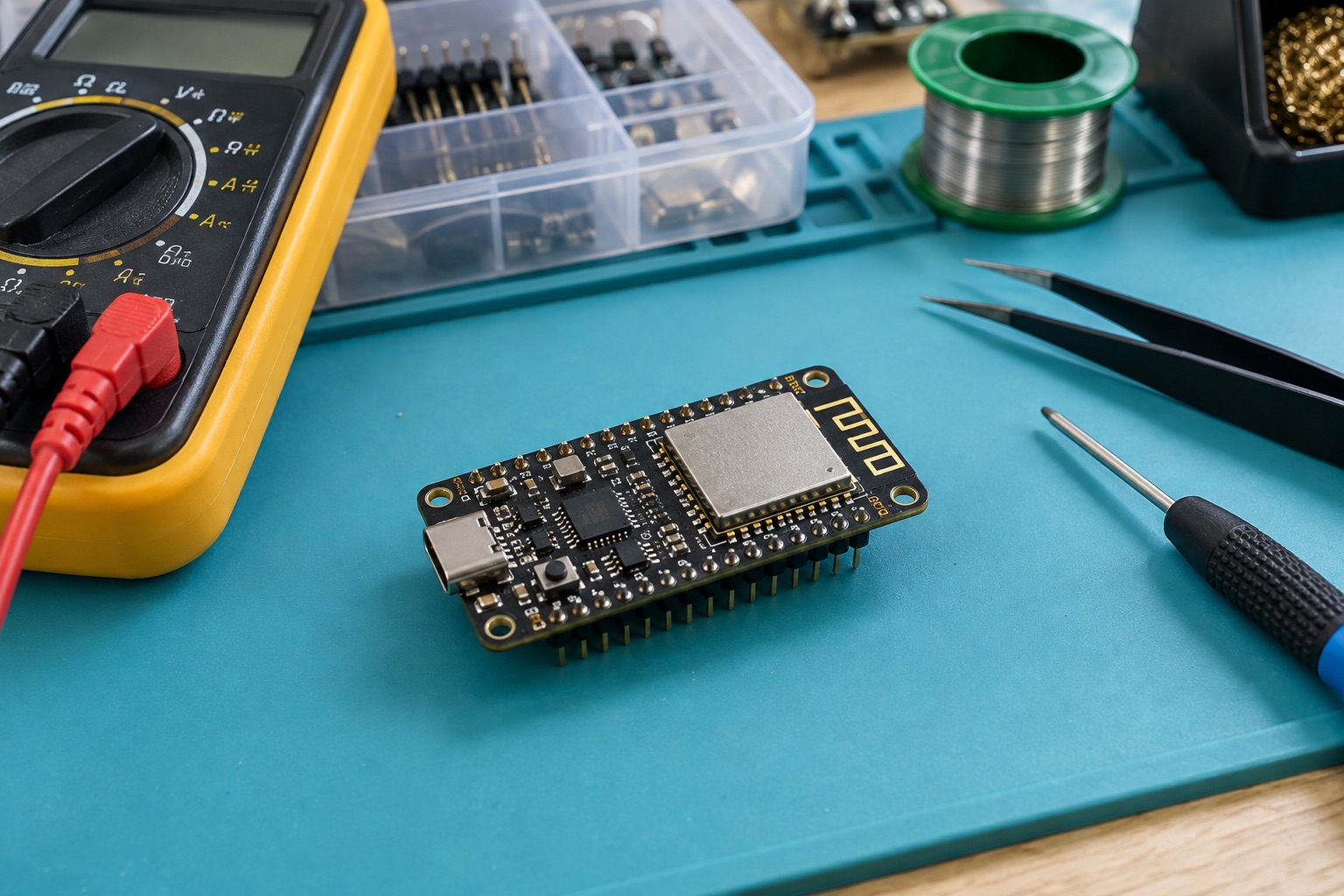
AI-generated engineering illustration; not a photograph of a verified Espressif board or a published test setup.
Quick Answer#
Espressif Systems, known in Chinese as Lexin, makes the ESP32 family of microcontroller SoCs used in connected sensors, appliances, controllers, and compact interfaces. Evaluate ESP32 when a product needs embedded firmware, local I/O, and modest processing with wireless connectivity. Start elsewhere when the requirement is a conventional Linux distribution, Android applications, large computer-vision models, or desktop-class graphics.
This vendor section contains seven guides, including this overview. It covers selected, established ESP32 families rather than claiming to list every Espressif product. Recommendations are engineering judgments based on public documentation, not rankings from an in-house benchmark. Specifications should be checked against the exact chip, module, and SDK release before purchase.
Choose A Guide#
| Engineering Question | Guide | Decision It Supports |
|---|---|---|
| Which ESP32 family fits? | ESP32 series selection | Radio, memory, and workload shortlist |
| Need a display, camera, or local inference? | ESP32-S3 guide | Application and memory budgeting |
| Need a compact Wi-Fi controller? | ESP32-C3 guide | Cost-sensitive connected products |
| Need Wi-Fi and Thread options? | ESP32-C6 guide | Connected-home architecture |
| Need a Thread or Zigbee endpoint? | ESP32-H2 guide | Low-power mesh devices |
| Preparing firmware for shipment? | ESP-IDF and secure OTA | Reproducible releases and recovery |
Understand The Product Category#
A microcontroller generally runs one integrated firmware application with tasks, interrupts, drivers, and a networking stack. Its memory and execution model differ from a Linux application processor running separately managed processes. This distinction affects staffing, debugging, updates, and the amount of third-party software that can be reused without adaptation.
For a thermostat, a compact MCU can own buttons, sensing, display updates, and network messages. For a kiosk needing browser rendering, video conferencing, and remote desktop support, that same architecture becomes restrictive. The useful question is whether the complete application fits with operating margin, not whether a demonstration can be made to start.
An ESP32 can also complement a larger processor. A Linux host might handle the interface while an MCU manages wake events or local peripherals. Such a split needs a documented communications protocol, reset sequence, and update compatibility policy. Adding a second chip only helps when the responsibilities are clearly divided.
Separate Chips, Modules, And Development Boards#
The SoC is the silicon component. A module combines a chip with selected supporting components and an antenna arrangement. A development board adds convenient power, connectors, and debugging access. These names are not interchangeable purchase specifications, even when marketplace listings use them loosely.
Start prototype purchasing with an exact module ordering code. Record flash capacity, external RAM if present, antenna type, permitted temperature range, and board schematic revision. A tutorial using a similar-looking board may assign pins that are unavailable or reserved on the chosen module. Treat photographs as orientation aids, never as pinout documentation.
Modules can reduce RF integration effort, but the final enclosure and board still affect performance. Antenna placement, nearby metal, display cables, and battery position can all change the installed link. Certification evidence also has scope and conditions; a module certificate does not automatically approve every finished product or antenna arrangement.
Match Connectivity To The Installation#
Write down who controls the network. A consumer Wi-Fi device depends on customer credentials and router behavior. A Thread endpoint depends on an appropriate Thread network and, for communication with adjacent IP networks, a border router. A Zigbee installation needs its own compatible network and application integration. These dependencies belong in the product specification.
Bluetooth Low Energy is useful for nearby interactions and commissioning, but it is not Bluetooth Classic. An audio accessory requiring a Classic profile cannot be selected by looking for a generic Bluetooth logo. Likewise, Matter describes an application ecosystem; it is not the name of a radio and does not eliminate commissioning or product certification work.
Compare the supported radios through the Espressif product selector. Then choose the software stack and operational role. Radio capability establishes what may be possible; it does not prove that every combination of protocols can run simultaneously with acceptable memory use, latency, or battery life.
Budget Resources Before Board Design#
Build an early resource worksheet around the final application. Include application code, two update images where required, persistent settings, certificates, logging, graphics assets, and manufacturing data. Runtime memory must cover stacks, network buffers, cryptography, and peak application allocations together. Spare flash does not compensate for exhausted internal RAM.
Measure transitions as well as steady operation. Commissioning, reconnection, certificate processing, firmware download, and factory reset often create different resource peaks. A product that runs comfortably while idle may reset during an update. Capture the smallest free heap, largest available block, task stack margin, and reset reason under those conditions.
| Budget | What To Include | Typical Oversight |
|---|---|---|
| Electrical | Radio bursts, sensor startup, regulator loss | Measuring only average current |
| Memory | Connectivity plus application peaks | Testing components separately |
| Storage | Update slots, data, future growth | Shipping with no update headroom |
| Timing | Interrupts, logging, reconnection | Judging only normal operation |
| Support | SDK migration, credentials, incident response | Budgeting hardware cost alone |
Treat Software Maintenance As A Deliverable#
ESP-IDF is Espressif’s official development framework. Choose a supported release suitable for the target and required components, then pin the toolchain and dependencies. Avoid treating a moving documentation alias or a developer’s laptop installation as a reproducible release definition. Store configuration and partition layout beside the application source.
Allocate maintenance ownership before launch. Someone must monitor relevant advisories, assess their applicability, build a fix, and deliver it to devices that may have been offline for months. Document what happens when a cloud endpoint changes, a certificate expires, or a customer replaces the home network. Those cases are normal product operations.
Plan Manufacturing And Service Together#
Production testing should prove more than successful flashing. Exercise power rails, communications, sensors, buttons, and the antenna path with fixtures suited to the product. Assign unique identities through a controlled process. Keep records linking board revision, firmware hash, and test result without putting private keys into ordinary factory logs.
Security settings can affect later service access. Define whether a returned unit can be reflashed, which operations erase customer data, and when replacement is necessary. Run the procedure on sacrificial samples before provisioning a pilot batch. A reliable service policy must match the actual fuse state and boot configuration of shipped hardware.
Evaluate Evidence And Suppliers#
Ask suppliers for traceable ordering information, schematics, antenna guidance, change notifications, and documented support boundaries. A demonstration video establishes very little about low-temperature startup, radio coexistence, or firmware longevity. Request test conditions and firmware versions whenever a performance claim influences purchasing.
For procurement, compare total delivered cost: module, power supply, sensors, enclosure constraints, certification effort, factory time, and engineering maintenance. A cheaper chip can produce a more expensive product when it increases integration work. Conversely, selecting a larger MCU without a workload reason adds cost without solving a defined risk.
FAQ#
Can ESP32 replace a Linux SBC? It can replace one when the task is small enough to implement as MCU firmware. It is not a drop-in replacement for Linux applications, containers, or Android software. Evaluate the application requirements before comparing board prices.
Does every ESP32 include Wi-Fi? No. ESP32-H2, for example, targets Bluetooth LE and IEEE 802.15.4 connectivity. Family names alone are insufficient; verify the radio block for the exact device.
Are these guides based on hands-on benchmark results? No. They combine official-source facts with explicit engineering evaluation advice. No measured throughput, battery life, certification status for a finished product, or supplier endorsement is implied.
Sources And Editorial Basis#
Reviewed September 18, 2026. Use the official product selector for current variants and the ESP-IDF documentation for target-specific implementation details. See our editorial policy for source discipline and the software guides for broader platform comparisons.